A fleet manager is the operational leader responsible for the vehicles, drivers, and heavy equipment that keep an organization moving — from a 50-truck logistics company in Dubai to a 500-machine construction operation supporting NEOM. The role sits at the intersection of three forces that have intensified sharply in 2026: cost pressure as fuel and maintenance budgets compress margins, sustainability mandates as the UAE and Saudi Arabia accelerate net-zero commitments, and safety scrutiny as HSE enforcement tightens across the GCC.
This guide breaks down what fleet managers actually do day to day, how the role looks different across construction, logistics, mining, and energy, the skills you need to do it well, and the technology shift that’s reshaping the function from a back-office cost center into a strategic operations role.
What does a fleet manager do?
A fleet manager is accountable for the total cost of ownership, uptime, safety, and compliance of an organization’s vehicle and equipment fleet. That ownership extends from the moment a vehicle or piece of heavy equipment is procured through every kilometer it operates, every hour it sits idle, every gallon of fuel it burns, and every regulatory inspection it passes — until the day it’s resold, repurposed, or retired.
In smaller organizations, a single fleet manager wears every hat: procurement, scheduling, maintenance oversight, driver management, compliance reporting, and budget control. In large GCC enterprises operating mega-project fleets, the role splits into specialized functions — a fleet director sets strategy while regional managers run day-to-day operations, supported by maintenance managers, safety officers, and analysts.
Crucially, the modern fleet manager is no longer a back-office logistics function. They sit at the table with the CFO when discussing OPEX, with the EVP of Operations when planning capacity, with the HSE director when reviewing safety incidents, and with the head of sustainability when emissions targets are missed. The role exists to keep the fleet productive without letting cost, risk, or carbon drift.
7 core responsibilities of a fleet manager
The role decomposes into seven recurring areas of accountability. Most fleet managers operate across all seven simultaneously, with the weighting shifting based on industry, fleet size, and where the organization is in its modernization journey.
Vehicle and equipment procurement
Procurement decisions made today determine cost and capability for the next 5 to 15 years. The fleet manager is responsible for matching equipment specifications to operational requirements — wrong tonnage on a haul truck, undersized hydraulics on a wheel loader, or the wrong telematics OEM choice can cost millions in inefficiency before the asset is replaced. In the GCC, procurement also requires navigating regional regulatory requirements (homologation, customs, local content rules) and increasingly, sustainability criteria when bidding on government-linked projects.
Preventive maintenance and uptime
Unplanned downtime is the single largest controllable cost in most fleets. A construction excavator on a critical path can cost a contractor AED 30,000 or more per day in delay penalties. Fleet managers are responsible for designing and enforcing preventive maintenance schedules — typically based on engine hours, kilometers, or fuel consumption — and for ensuring spare parts inventory, technician availability, and workshop capacity match the fleet’s actual demand profile rather than vendor-recommended assumptions.
Cost control and budgeting
Fleet managers own the operating budget for fuel, lubricants, tires, parts, labor, insurance, and licensing. They are also responsible for forecasting capital requirements for fleet renewal. In a typical GCC heavy-equipment operation, fuel alone can exceed 30 percent of total fleet OPEX — making fuel-card management, anti-pilferage controls, and route optimization material to the P&L.
Driver management and safety
The fleet manager is responsible for hiring, licensing verification, induction training, ongoing performance coaching, and disciplinary action across drivers and equipment operators. In safety-critical industries — mining, oil and gas, transportation of dangerous goods — this responsibility extends to driver fatigue management, behavior monitoring through telematics, and post-incident investigation.
Compliance and regulatory reporting
Compliance touches every part of the fleet: vehicle registration and inspection (Emirates Vehicle Inspection Centre, Saudi MVPI), driver licensing categories, working-hour rules, hazardous-materials transport permits, environmental compliance, and customs paperwork for cross-border movements between GCC states. Fleet managers maintain the documentation trail and respond to audits.
Real-time fleet visibility and analytics
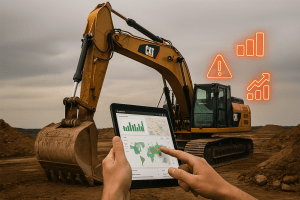
Modern fleet managers don’t manage what they can’t see. Telematics, GPS tracking, driver-facing apps, and integrated fleet management software give them live position data, vehicle health alerts, fuel consumption patterns, geofence violations, and driver behavior scores. The shift from monthly fuel reports to real-time dashboards has fundamentally changed what’s possible — and what’s expected — in the role.
Sustainability and emissions reporting
This is the newest and fastest-growing responsibility. The UAE’s Net Zero by 2050 strategy, Saudi Arabia’s Vision 2030 sustainability targets, and increasingly stringent emissions reporting requirements for government contractors mean fleet managers now own carbon accounting alongside cost. They track CO2 and methane emissions per vehicle, model fleet electrification scenarios, and produce ESG disclosures for regulators, investors, and major clients. In construction and mining, this responsibility didn’t exist five years ago. By 2026, it is a core part of the job description.
How the fleet manager role differs by industry
While the seven responsibilities are universal, the title, scope, and emphasis vary significantly by vertical. Understanding these differences matters whether you are hiring, structuring a team, or benchmarking your own role.
Construction — PMV / Equipment Manager
In construction, the fleet manager is more often called a PMV Manager (Plant, Machinery & Vehicles) or Equipment Manager. The fleet skews heavily toward off-road heavy equipment — excavators, wheel loaders, dump trucks, cranes, concrete pumps — alongside on-road vehicles. Utilization is everything: an idle wheel loader on an active site burns rental cost without producing revenue. PMV managers in GCC mega-projects often coordinate equipment movement across multiple sites, manage subcontractor equipment alongside owned fleet, and report to a Construction Manager or Director of Operations rather than a logistics function.
Logistics & mobility — Fleet Director
In road freight, last-mile, and logistics operations, the equivalent role is Fleet Director or Head of Operations & Commercial — Road Freight. The fleet is more uniform (light commercial vehicles, prime movers, trailers), but the operational complexity comes from route density, driver shifts, customer SLAs, and load planning. KPIs center on cost-per-kilometer, on-time delivery, and driver retention. The Fleet Director typically reports to a COO or commercial leader, with HSE and sustainability adjacent rather than directly owned.
Mining — Operations Director / Asset Manager
Mining fleets are smaller in count but staggering in scale per asset — a single haul truck can cost 5 million USD and burn over 2 million USD of fuel per year. The role here is typically split: a Mining Operations Director owns production and equipment availability, while an Asset & Maintenance Manager owns reliability and lifecycle. Remoteness, harsh operating conditions, and 24/7 production create unique demands around predictive maintenance, parts inventory at remote sites, and operator training. Sustainability and environmental compliance increasingly sit within the role.
Energy / Oil & Gas — Asset & Maintenance Manager
In upstream and midstream energy, fleet management overlaps heavily with broader Asset and Maintenance Management. The fleet includes specialized vehicles (water trucks, pump trucks, wireline units), heavy equipment, and high-value mobile assets operating in geographically dispersed and often hazardous environments. Compliance is intense — methane emissions, hazardous goods transport, contractor safety. The Asset & Maintenance Manager typically reports into an Operations VP and works closely with the HSE and sustainability functions.
Skills and qualifications of an effective fleet manager
The skills required have shifted significantly over the past decade. Operational and mechanical knowledge are now table stakes; the differentiator is the ability to translate fleet data into business outcomes.
Operational and analytical skills
Effective fleet managers can read a maintenance ledger, a fuel report, a driver scorecard, and a utilization dashboard — and then explain to senior leadership what is actually driving cost or risk. Comfort with spreadsheets, BI tools, and increasingly AI-generated analytics is non-negotiable.
Financial acumen
Fleet managers manage budgets in the millions. Strong candidates understand total cost of ownership, residual value calculations, lease-versus-buy economics, and how fleet decisions flow through the P&L and balance sheet. Conversations with the CFO are easier when both parties speak the same numbers.
Technology fluency
A modern fleet manager is expected to evaluate telematics platforms, integrate fleet management software with ERP and HR systems, assess AI-powered predictive maintenance tools, and pilot electric and alternative-fuel options. They don’t need to be developers — but they need to know enough to ask the right questions of vendors and IT.
Communication and leadership
The role spans drivers, mechanics, dispatchers, finance partners, HSE, and the executive team. Fleet managers who can clearly communicate operational realities to executives and strategic priorities to drivers consistently outperform those who can do only one or the other.
Regulatory and HSE knowledge
In the GCC specifically, knowledge of UAE Federal Transport Authority rules, Saudi Transport General Authority requirements, GCC standardization specifications for vehicles, and emerging emissions regulations is increasingly prized. Mistakes here cost real money in fines and lost contracts.
Most large GCC employers prefer candidates with a bachelor’s degree in supply chain, logistics, engineering, or business administration. Industry certifications — NAFA’s CAFM (Certified Automotive Fleet Manager), CAFS (Certified Automotive Fleet Specialist), or vendor certifications from major OEMs — strengthen profiles. Practical experience managing 100+ assets, demonstrated cost-reduction outcomes, and exposure to telematics platforms are typically what hiring managers screen for.
Top challenges facing fleet managers in 2026
The job has gotten harder in measurable ways over the past three years. Five challenges are reshaping how the role is staffed and what tools fleet managers demand.
Rising fuel and maintenance costs
Even with stable oil prices, parts inflation, technician wage growth, and supply chain delays have pushed maintenance costs up across the GCC. Fleet managers face the same operational targets with budgets that haven’t grown in real terms.
Aging fleets and asset lifecycle pressure
A combination of post-pandemic capex deferrals and supply constraints on new equipment has aged many GCC fleets beyond their economic sweet spot. Fleet managers are forced to extend the operational life of equipment that’s costing more per hour to keep running.
Sustainability mandates and emissions reporting
UAE Net Zero 2050, Saudi Arabia’s Green Initiative, and increasingly common Scope 3 emissions disclosure requirements from major clients mean fleet managers must now produce credible carbon accounting at the asset level. Most fleets weren’t instrumented for this even two years ago.
Driver shortage and retention
Qualified drivers — especially for heavy equipment, hazardous materials, and long-haul routes — are scarce across the GCC. Wage inflation, immigration policy shifts, and competition from other industries have pushed turnover costs to record levels.
Data fragmentation across multiple systems
Most fleet managers run telematics from one vendor, fuel cards from another, maintenance software from a third, ERP integration on a fourth, and homegrown spreadsheets to tie it all together. Reconciling this data eats hours every week and obscures the insights that would otherwise drive better decisions. The shift toward single-platform fleet management is the most discussed solution to this problem in 2026.
How technology is transforming fleet management
The fleet manager role is being reshaped by three converging technology trends.
Telematics and IoT. Real-time location, engine diagnostics, fuel consumption, and driver behavior data flow continuously from vehicles and equipment into management dashboards. What used to require monthly inspections now updates every second.
AI and predictive maintenance. Machine learning models trained on telematics data predict component failures days or weeks before they happen, shifting maintenance from reactive to truly preventive. For a haul truck or a tower crane, the ROI is measured in avoided downtime worth tens of thousands per day.
Single-platform consolidation. Rather than stitching together five vendor tools, modern fleet managers are increasingly demanding integrated platforms that combine telematics, maintenance management, fuel tracking, driver management, sustainability reporting, and compliance into a single source of truth. This is particularly valuable in GCC heavy-equipment fleets where the cost of integration sprawl is highest.
For fleet managers running 100+ heavy vehicles or pieces of equipment in the GCC, the technology question is no longer “should we modernize?” — it is “which platform gives us the visibility, control, and sustainability reporting we’ll need over the next five years?” Tenderd was built specifically for this profile of operation, with a single-platform approach to fleet, equipment, emissions, and compliance.
Frequently Asked Questions
What’s the difference between a fleet manager and a fleet operator?
A fleet manager is responsible for the strategic and operational ownership of the entire fleet — procurement, budget, compliance, and performance. A fleet operator typically refers to a driver or equipment operator who actually runs the vehicle in the field. In some organizations, fleet operator is also used to describe the company itself when it owns and runs vehicles as part of its business. The distinction matters when reading job descriptions or vendor materials.
How is a PMV manager different from a fleet manager in construction?
PMV (Plant, Machinery & Vehicles) Manager is the construction industry’s term for what other industries call a fleet manager, but with a heavier weighting toward off-road heavy equipment — excavators, wheel loaders, cranes, concrete equipment, and dump trucks — alongside on-road vehicles. The KPIs differ too: PMV managers focus heavily on equipment utilization across multiple sites, rental cost optimization, and integration with project schedules. The skill set overlaps significantly with fleet management but adds heavy-equipment expertise.
What KPIs does a fleet manager own?
The standard set includes total cost of ownership per vehicle or per kilometer, equipment utilization, unplanned downtime hours, preventive maintenance compliance rate, fuel efficiency, accident frequency rate, driver retention, regulatory compliance score, and increasingly, CO2 emissions per asset. The exact mix depends on industry — a logistics fleet director will track on-time delivery and cost per drop, while a mining asset manager will focus on availability and mean time between failures.
Do fleet managers need a CDL?
A Commercial Driver’s License is generally not required to manage a fleet — managing is distinct from driving. However, in some smaller operations or in specialized fleets like fuel transport or heavy haul, hands-on familiarity (and sometimes the appropriate license) is preferred. In the GCC, the equivalent is having held a heavy-vehicle driving permit at some point, which gives credibility when working with drivers and operators.
How is the fleet manager role evolving with sustainability mandates?
Significantly. Five years ago, sustainability was a nice-to-have. Today it is a core part of the job description in any organization with government contracts, public reporting requirements, or major-client ESG mandates. Fleet managers now need to track and report carbon emissions per vehicle, model fleet electrification scenarios, and integrate sustainability metrics alongside cost and uptime. The role is shifting from cost center to strategic owner of an organization’s largest source of operational emissions.
Conclusion
The fleet manager role has expanded far beyond keeping vehicles on the road. In 2026, it sits at the intersection of three pressures that aren’t going away: cost discipline as margins compress, sustainability mandates as net-zero deadlines approach, and safety scrutiny as regulators tighten enforcement. The fleet managers who thrive are the ones who treat their function as a strategic operations role — fluent in finance, data, and emerging technology — rather than a back-office logistics function.
For organizations operating 100+ vehicles or pieces of heavy equipment in the GCC, the question isn’t whether to invest in better fleet management tools and processes — it is how quickly to consolidate the fragmented stack into a single, accountable platform. Tenderd’s single-platform approach was built for exactly this profile of operation: heavy equipment, multiple sites, GCC regulatory complexity, and growing sustainability demands.