 TL;DR: One-Minute Brief
 TL;DR: One-Minute Brief
The first thirty minutes of most shifts get spent the same way, a dispatcher or supervisor calling around to confirm which machines actually made it to which site overnight, before any real planning for the day can start. This blog covers why that morning roll call keeps happening even at fleets with GPS already installed, and how live location, status, movement history, and geofence visibility from one platform lets a team locate every asset instantly instead of reconstructing it by phone. Keywords: live equipment tracking, GPS fleet location, equipment status dashboard, geofence visibility, locate assets instantly.
The Workday Doesn’t Start Until the Phone Calls Are Done
Before any real planning happens, the first thirty minutes of a typical shift disappear into the same ritual: a supervisor or dispatcher calling around, site by site, to confirm which machines actually arrived where they were supposed to overnight, which ones are still sitting at the previous location, and which ones nobody has heard from yet. Only once those calls are done does the actual day’s work begin, assigning tasks, releasing machines to their next job, telling a client when their delivery will move.
This happens even at fleets that already have GPS installed on every vehicle. The location data exists. What’s missing is a habit, and often a system, that makes checking it faster than picking up the phone. If pulling up a report takes longer than calling a site supervisor directly, the phone call wins by default, every single morning, regardless of how much tracking technology is technically available.
Why Does the Morning Roll Call Keep Happening Anyway?
A few things keep this ritual alive even where the technology exists to skip it. Location data might be tracked but scattered across a system nobody checks first thing in the morning, or split across separate views for different equipment types so no one screen shows the whole fleet at once. Status information might exist but not distinguish between a machine that’s working, one that’s idling, and one that’s simply switched off, so a quick glance doesn’t actually answer “did it arrive,” it just shows a dot on a map. And without geofences configured around key sites, there’s no automatic way to confirm arrival at all, someone still has to manually check whether a machine’s coordinates actually match where it was supposed to end up.
The result is that even fleets with tracking hardware installed end up defaulting back to the phone, because the phone call, however inefficient, reliably answers the question in one step, while checking the system might not.
How Do Teams Typically Handle This Before Their Shift Starts?
- Call each site supervisor individually to confirm which machines arrived overnight.
- Cross-check a location report against a manual list of where each machine was supposed to end up.
- Wait for someone at each site to notice and report an equipment no-show, rather than seeing it immediately.
- Treat a dot on a map as confirmation of arrival, without a way to automatically verify it matches the intended site.
- Repeat the entire process the next morning, since nothing from the previous day’s calls carries forward automatically.
None of this is a failure of effort. It’s what happens when checking a system takes longer, or answers less clearly, than simply asking a person directly.
What Changes When Every Machine’s Status Is Visible From One Screen?
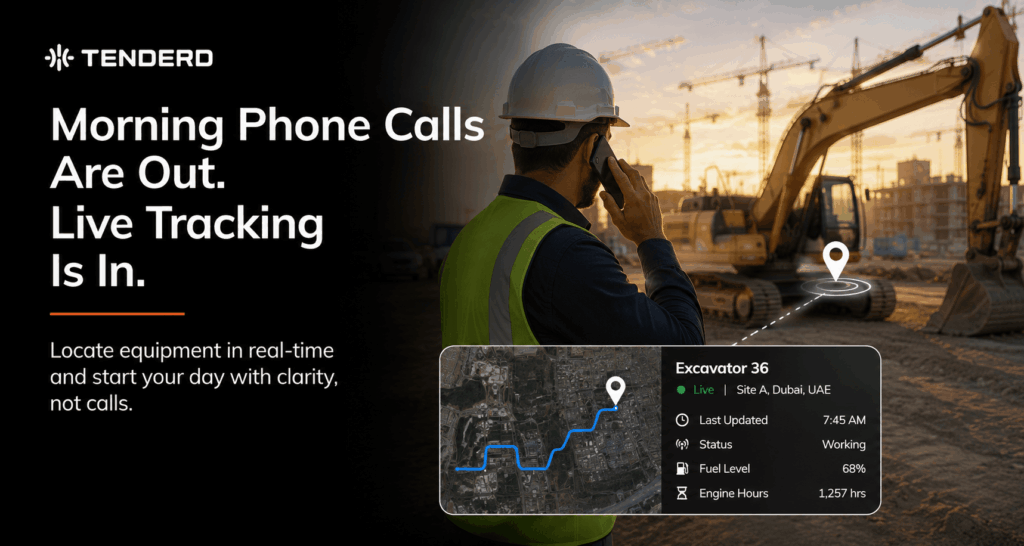
The fix is making the system faster to check than the phone, not just technically capable of showing the same information. Every piece of equipment reports its live location and a colour-coded status, working, idling, off, or disconnected, to one shared view, so a quick glance answers “where is it and what’s it doing” without a call. Geofences drawn around each site turn “did it arrive” into an automatic confirmation rather than a manual coordinate check: entering or exiting a defined zone is logged the moment it happens, so arrival status is already known before anyone asks.
For anything that still needs a closer look, a machine’s recent movement history, along with ignition, speed, distance, and fuel charts for a selected date, is available directly, which answers most follow-up questions on its own rather than requiring another phone call to a site supervisor for details. The morning roll call shrinks from a round of calls to a single glance at a screen that already has the answer.
Phone-Based Roll Call vs. Live Status Visibility
| Factor | Phone-Based Roll Call | Live Status Visibility |
| Confirming a machine’s arrival | Call the site and ask | Automatic geofence entry log |
| Checking current status | Ask someone to look and report back | Colour-coded status visible instantly |
| Time to complete the check | Series of calls across every site | A single glance at one screen |
| Follow-up questions | Another round of calls | Movement history and charts available directly |
| Consistency day to day | Repeated manually every morning | Same live view, always current |
Common Mistakes That Keep the Morning Roll Call Alive
- Having GPS data available but split across separate views instead of one consolidated screen.
- Treating a location dot on a map as confirmation of arrival, without a geofence to verify it automatically.
- Reporting status as simply “on” or “off” rather than distinguishing working, idling, and disconnected.
- Requiring a manual check against a separate list of where each machine was supposed to end up.
- Making the system slower to check than a phone call, which guarantees the phone call keeps winning.
How Tenderd Helps Replace the Morning Roll Call
Tenderd’s Track module gives every machine a live location and colour-coded status, working, idling, off, or disconnected, visible from one platform without needing to call anyone. Geofences configured around each site automatically log entry and exit, turning arrival confirmation into something already known rather than something to check by phone, and a machine’s movement history along with ignition, speed, distance, and fuel charts is available directly for any follow-up question.
The Bottom Line
The morning roll call survives not because fleets lack tracking technology, but because checking it is often slower than calling someone directly. Making live location, status, and geofence confirmation faster to check than a phone call is what actually breaks the habit, not just having the data available somewhere in the system.
Want to see how a live status view could replace your team’s morning roll call? Get in touch with the Tenderd team for a walkthrough: Book a Demo
Frequently Asked Questions
Why do fleets with GPS still spend the morning calling around to locate machines?
Location data may exist, but if it's scattered across separate views or slower to check than picking up the phone, teams default back to calling, since a phone call reliably answers the question in one step.
How does a geofence confirm a machine's arrival automatically?
A geofence is a virtual boundary drawn around a site. Entering or exiting it is logged the moment it happens, so arrival can be confirmed automatically rather than by manually matching coordinates to an expected location.
What does a colour-coded equipment status actually show?
It distinguishes whether a machine is actively working, idling with the engine on, switched off, or disconnected, giving a clearer answer than a single dot on a map showing only location.
Can follow-up questions be answered without calling a site supervisor?
Yes. A machine's recent movement history along with ignition, speed, distance, and fuel charts for a selected date can be reviewed directly, covering most of what a follow-up call would otherwise be needed for.
Does this replace the need for any communication with site teams?
It replaces the routine, repetitive status-checking calls specifically. Communication for actual coordination, task assignment, or exceptions still happens, but it no longer has to start with confirming basic location and status first.