 TL;DR: One-Minute Brief
 TL;DR: One-Minute Brief
A fuel report flags that a machine’s fuel level changed by a certain amount on a certain day, but doesn’t say whether that change was a refill or a drop, so every single entry on the report has to be individually chased down before anyone knows if it’s routine or worth worrying about. This blog covers why a report that only shows “fuel level changed” creates more work than it saves, and how splitting every event into a clearly labeled refill or drop turns a report nobody trusts into one that’s actually usable at a glance. Keywords: fuel event reporting, fuel drop vs refill, fuel report clarity, fuel investigation software, fuel level change alert.
A Report That Answers the Wrong Question
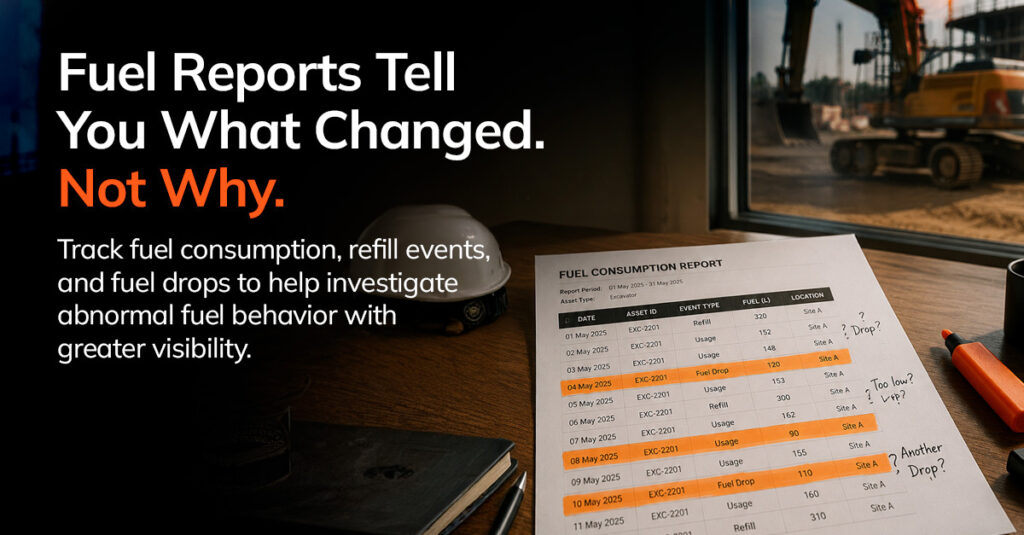
A fuel report lands on a fleet manager’s desk showing a list of fuel level changes for the week: machine four changed by eighteen liters on Tuesday, machine nine changed by forty liters on Thursday, and so on down the list. What the report doesn’t say, for any of these entries, is whether the fuel level went up or down. A forty-liter change could be a routine refill at the start of a shift. It could just as easily be a forty-liter loss that deserves an urgent look. The report itself can’t tell the difference, and neither can whoever is reading it, without opening each entry individually to check.
That single missing distinction turns a report meant to save time into one that creates more work than it saves. Instead of scanning a page and immediately knowing which entries matter, the fleet manager has to treat every single line as a potential problem until proven otherwise, clicking into each one, checking the direction of the change, and only then deciding whether it’s worth a second look. A report that raises a question on every line, rather than answering most of them outright, stops being something people actually read regularly, and starts being something they skim past or ignore.
Why Does a Fuel Report End Up Raising More Questions Than It Answers?
The core problem is treating “the fuel level changed” as if it were one type of event, when it’s actually describing two completely different things that happen to look similar on a chart. A refill and a drop are both just a change in fuel level, but they mean opposite things operationally: one is routine, expected, and usually not worth a second glance, the other is a candidate for a leak, a mechanical issue, or theft, and deserves immediate attention. A report format that doesn’t separate these from the start forces every reader to do that separation manually, one entry at a time, which is exactly the work a report is supposed to remove.
This gets worse at scale. A fleet of even a modest size can generate dozens of fuel change entries a week, and if each one requires an individual click to determine whether it’s a refill or a drop, the report becomes something people stop trusting to be quick, and start avoiding, or worse, start ignoring the individual entries and only checking in when the total looks unusually large, missing smaller but still meaningful drops along the way.
How Do Teams Typically Deal With Ambiguous Fuel Reports Today?
- Open each fuel change entry individually to determine whether it was an increase or a decrease.
- Rely on the size of the change as a rough proxy for whether it’s worth investigating, rather than the direction.
- Skim past most entries and only look closely at ones that seem unusually large.
- Ask a site supervisor to confirm whether a specific change was a scheduled refill, since the report itself doesn’t say.
- Stop checking the report regularly once it becomes clear that every entry requires individual follow-up to interpret.
Each of these workarounds treats the report’s core ambiguity as something to manage around, rather than something that should have been resolved in the report itself.
What Changes When Every Event Is Already Labeled as a Refill or a Drop?
The fix is simple to describe and meaningfully different in practice: classify every fuel level change as either a refill or a drop the moment it’s detected, so the report itself already answers the question that used to require opening each entry individually. A glance at the list immediately separates routine refueling activity from the drops that actually deserve investigation, without anyone needing to click into a single entry just to find out which direction the number moved.
From there, a “drop only” view isolates exactly the entries that matter for theft or leak investigation, filtering out every routine refill automatically rather than requiring a manual scan to skip past them. Each classified event also carries a confidence rating, reflecting how certain the system is that a real change occurred rather than sensor noise, so even among the drops, attention can be prioritized toward the ones most likely to be genuine rather than treating every flagged entry as equally urgent.
Ambiguous Fuel Reports vs. Pre-Classified Refill and Drop Reports
| Factor | Ambiguous Fuel Reports | Pre-Classified Refill and Drop Reports |
| What each entry shows | A change amount, direction unclear | Clearly labeled as a refill or a drop |
| Time to interpret an entry | Requires opening it individually | Immediately clear from the list |
| Isolating theft or leak candidates | Manual scan through every entry | A single toggle to show drops only |
| Prioritizing which drops matter most | Treated equally without more detail | Ranked by a confidence rating |
| Trust in the report over time | Erodes as ambiguity accumulates | Maintained since entries are self-explanatory |
Common Mistakes That Make Fuel Reports Harder to Use Than They Should Be
- Reporting a fuel level change without labeling whether it was a refill or a drop.
- Using the size of a change as a proxy for urgency, instead of its direction and a confidence rating.
- Requiring a manual scan to separate routine refills from entries that actually need investigation.
- Treating every flagged drop as equally urgent, without a way to prioritize the most likely genuine ones.
- Letting a report become something people skim or ignore because every entry demands individual follow-up.
How Tenderd Helps Make Fuel Reports Immediately Usable
Tenderd’s Fuel Intelligence platform classifies every fuel level change as a refill or a drop the moment it’s detected, so a report already shows which entries are routine and which deserve a closer look, without opening each one individually. A drop-only view isolates theft and leak candidates automatically, and every classified event carries a confidence rating, helping prioritize attention toward the changes most likely to be genuine rather than sensor noise.
The Bottom Line
A fuel report that doesn’t say whether a change was a refill or a drop isn’t really answering the question it was built to answer. It’s just describing the problem and leaving the interpretation to whoever reads it. Labeling every event the moment it’s detected turns a report that raises questions into one that actually answers them.
Want to see what a fuel report that’s already sorted into refills and drops looks like for your fleet? Get in touch with the Tenderd team for a walkthrough: Book a Demo
Frequently Asked Questions
Why isn't a fuel level change enough information on its own?
A change in fuel level could be a routine refill or a concerning drop, and those two situations call for completely different responses. A report that doesn't distinguish between them forces the reader to figure it out manually for every entry.
How does classifying fuel events as refills or drops save time?
It removes the step of opening each entry individually to determine its direction, since the report already labels it, letting someone scan a full list and immediately know which entries are routine and which need attention.
What does a "drop only" view actually filter out?
It hides routine refill events entirely, showing only the fuel level decreases that are candidates for theft, siphoning, or a leak, without requiring a manual scan through unrelated entries.
Why does a confidence rating matter even among flagged drops?
Not every detected drop is equally certain to be a genuine event rather than sensor noise. A confidence rating helps prioritize which flagged drops deserve immediate attention over ones that may simply be a noisy reading.
What happens when a fuel report stays ambiguous for too long?
Teams tend to stop trusting or regularly checking it, since every entry demands individual follow-up. That erodes the report's usefulness and increases the risk that a genuine drop gets missed among entries nobody has time to open one by one.