 Summary
 Summary
Automated fleet monitoring closes the night-time visibility gap by replacing manual checks and phone calls with continuous, machine-generated data. A live, color-coded map shows which machines are working, idle, or switched off after dark, geofences trigger alerts the moment equipment leaves an authorized zone outside working hours, and AI cameras watch yards and restricted areas without a person needing to be physically present. Shift-wise reporting then separates day, night, and overtime hours, so managers see what actually happened overnight instead of piecing it together the next morning.
Key Takeaways
- No manager can watch every machine and every gate at 2 a.m., which is exactly the gap night shifts and unattended jobsites create.
- Live location tracking, geofence alerts, and AI camera surveillance all keep working after dark the same way they do during the day.
- Shift-wise utilization data finally answers whether the night shift is producing or just running, instead of leaving it to guesswork.
The Night-Time Visibility Gap
Most fleet operations run on an unspoken assumption: someone is watching. A supervisor walks the yard, a dispatcher answers the radio, a manager glances at the lot on the way out. That assumption breaks down after dark. Night shifts run with fewer people on site, jobsites sit unattended for 12 to 16 hours between crews, and the person who would normally notice a machine idling or a gate left open is usually asleep.
This doesn’t mean less happens at night, only that less of it gets seen. Theft, unauthorized use, safety incidents, and plain inefficiency all concentrate in the hours when supervision is thinnest, and by the time anyone reviews it the next morning, the moment to act on it has already passed.
How Automated Monitoring Works After Hours
Night-time visibility isn’t a separate feature bolted on for after-hours use. It’s the same monitoring stack a fleet already runs during the day, still working once the sun goes down.
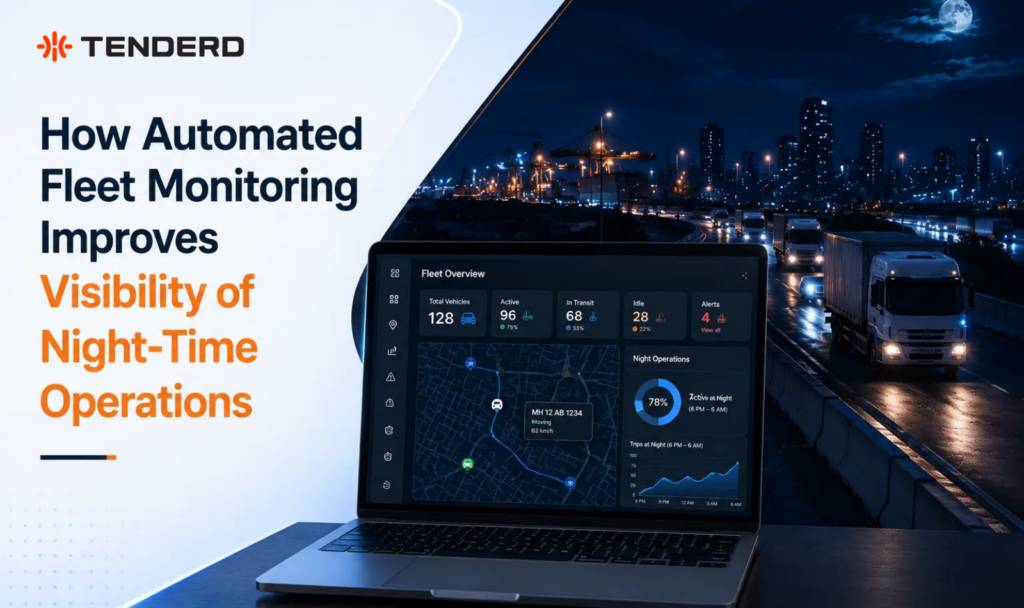
A live map shows every machine’s status through simple color coding, working, idle, switched off, or offline, and that status updates identically at 3 a.m. as it does at 3 p.m. This is what TENDERD’s Track module handles: geofenced boundaries around project sites, camps, and restricted zones keep generating entry and exit alerts around the clock, so a machine that leaves a yard at 1 a.m. gets flagged the same way one leaving at 1 p.m. would, with a timestamp logged either way. Where TENDERD’s AI Safety Camera is deployed, after-hours surveillance flags disturbances outside working hours, restricted-area monitoring catches unauthorized access, and gate monitoring keeps entry points under continuous watch.
Utilization and ignition-hour data, tracked through the Productivity module, is also broken out by shift, day, night, and overtime, with hourly patterns showing when machines are actually running versus sitting idle. That separation matters, because a single blended daily number can hide a night shift that’s mostly idle time, or one that’s quietly outperforming the day shift with no way to prove it. All of it, location, geofence activity, camera alerts, and shift-level productivity, lands in one view through Nexus, so nobody has to check three separate systems to understand what an overnight shift actually did.
The Cost of Limited Night-Time Oversight
The case isn’t theoretical. Industry theft-tracking data shows the majority of construction equipment theft happens between roughly 5 p.m. and 7 a.m., after crews leave and before the next shift arrives, with holiday weekends spanning 72 to 96 unattended hours marking documented peaks. Recovery odds are low once a machine is gone: heavy equipment lacks the titles and VIN databases that support vehicle recovery, and published recovery rates sit far below those for stolen cars.
Cameras alone aren’t the full answer, and the evidence is specific about why. A meta-analysis covering dozens of independent studies found actively monitored video surveillance measurably reduces crime at monitored sites, while passive footage with no live monitoring or alerting showed no significant effect. That’s the whole argument for alerting over recording: a clip nobody reviews until morning documents an incident after the fact, while a flag that fires the moment something happens gives someone a chance to respond while it’s still occurring. The same logic holds beyond theft too. A machine idling overnight wastes fuel whether or not anyone notices, and a hazard in a restricted zone is just as dangerous at 2 a.m. as at 2 p.m.
Key Operational Benefits
- Theft and unauthorized use: Track’s restricted geofences and after-hours movement alerts flag equipment leaving a site the moment it happens, not the next morning.
- Safety past shift end: AI Safety Camera coverage and restricted-area monitoring keep watching crane zones, heavy machinery yards, and entry points even when night staffing is thin.
- Honest night-shift numbers: Productivity’s shift-separated utilization and idle-time data replaces guesswork about whether the night crew is actually producing.
- Faster incident review: geofence timelines and location playback reconstruct exactly what happened overnight, instead of relying on conflicting accounts.
- Less manual checking: alerts do the routine polling, so attention only goes toward something that actually needs a response.
Beyond Construction: Other 24/7 Operations
Construction sites are a hard case because the risk and the operating pattern work against each other at once: sites are dispersed, temporary, and routinely left with millions in equipment sitting unattended for half a day, while law enforcement response in remote project areas can run into tens of minutes. But the same shape of problem shows up anywhere equipment runs around the clock. Mining and energy infrastructure sites operate continuously across shifts by design, and logistics or yard operations running overnight deliveries face freight and vehicles moving through a facility with the fewest people on hand to see it. Visibility that depends on someone being present simply doesn’t scale to hours when fewer people are.
Limitations to Plan Around
Automated monitoring closes the visibility gap, but it isn’t a complete substitute for planning. Real-time tracking still depends on network coverage, and remote or newly active sites can see delays reaching the dashboard. Camera coverage works best when zones are classified by risk first, crane areas and heavy machinery yards need denser coverage than low-traffic storage, and skipping that step leaves blind spots. An alert at 2 a.m. is only useful if someone, or an on-call process, is set up to act on it. And none of this replaces fencing, lighting, or secure storage; it adds the alerting and evidence layer that passive physical security can’t provide on its own.
Manual Supervision vs. Automated Monitoring
Automated fleet monitoring provides continuous visibility and faster response compared with relying on manual night supervision. The table below highlights the key differences between the two approaches:
| Dimension | Manual Night Supervision | Automated Fleet Monitoring |
| Coverage | Limited to what a supervisor can physically see or reach during a shift | Continuous, across every geofenced zone and connected machine at once |
| Response time | Depends on someone noticing in real time, or reviewing footage the next day | Alerts fire the moment a defined event occurs |
| Record-keeping | Verbal handovers and manual logs, prone to gaps | Timestamped geofence, location, and violation history for every machine |
| Productivity insight | Anecdotal impressions of how the night shift performed | Shift-separated utilization and idle-time data |
| Staffing dependency | Scales only by adding more people on site overnight | Scales across sites and shifts without added headcount |
The Bottom Line
Night-time operations aren’t inherently riskier or less productive than daytime ones. They’re just harder to see, and that gap is where theft, safety incidents, and quiet inefficiency tend to concentrate. Automated fleet monitoring doesn’t ask an operation to staff its way past that gap, it extends the same tracking, geofencing, and reporting that already runs during the day into the hours when fewer people are watching. The practical next step is simple: look at where night-time visibility is currently missing, unmonitored gates, unverified after-hours movement, a night shift with no real productivity data, and start there.
“See what your fleet is doing right now, day or night.” – Book demo
Frequently Asked Questions
Does automated fleet monitoring work if there's no supervisor on site overnight?
Yes. Location tracking, geofence alerts, and camera monitoring run continuously without needing anyone physically present. What still takes a person is responding once an alert fires, which is why an on-call process matters as much as the monitoring itself.
Can it tell if equipment moved without authorization overnight?
A restricted geofence logs an entry or exit violation with a timestamp and location the moment a boundary is crossed outside approved conditions, giving a clear record instead of relying on someone noticing a machine is missing.
How is night-shift productivity measured differently from day shift?
Utilization and ignition-hour data is broken into day, night, and overtime categories, so night-shift output can be judged against its own pattern rather than a blended daily average.