 Summary
 Summary
A forklift reverses down a busy aisle. The operator glances at a mirror, sees nothing, and keeps going. Most of the time nothing happens. Dubai has decided that most of the time is no longer good enough.
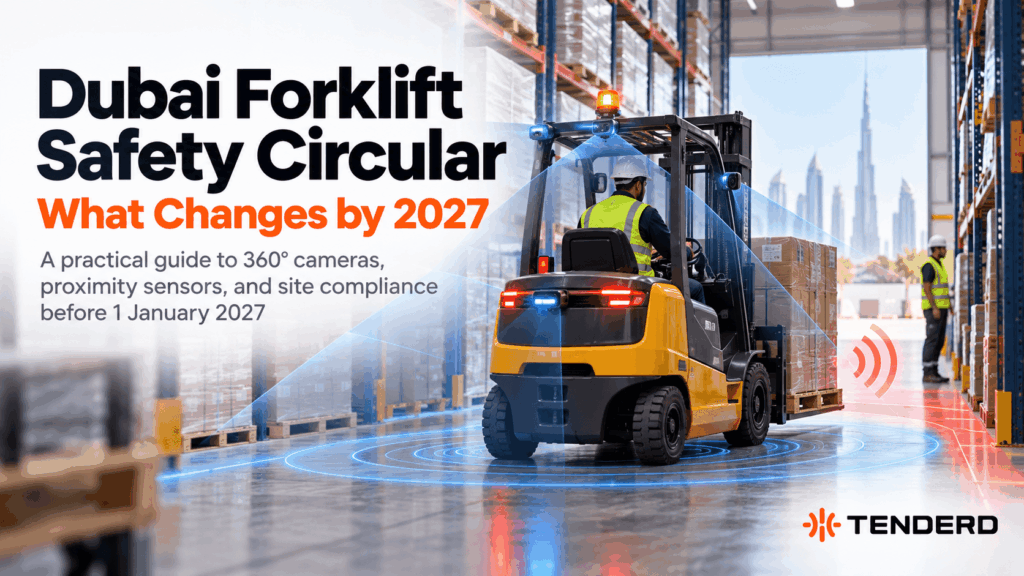
The Dubai forklift safety circular puts a date on that change. Every industrial facility and warehouse running forklifts in the emirate has until 1 January 2027 to fit surround-view cameras and proximity sensors, and to show that the rest of its forklift safety regime holds up to inspection.
This guide covers what the circular actually requires, which regulator applies to your site, what the supporting technical guideline specifies down to the number of cameras, and what to do between now and the deadline.
Key points at a glance
- Dubai Municipality issued an External Circular on Safe Forklift Operation, reference DM-EHS-CR01, dated 10 June 2026.
- PCFC and Trakhees followed with Circular No. 29 of 2026, applying the same requirements inside their jurisdiction.
- The requirements cover equipment fitted to the forklift as well as traffic routes, inspection records, operator training and daily discipline.
- Full implementation is required no later than 1 January 2027.
- Dubai Municipality has stated that its Occupational Health and Safety inspection teams will verify compliance.
What is the Dubai forklift safety circular?
The Dubai forklift safety circular is Dubai Municipality’s External Circular on Safe Forklift Operation, reference DM-EHS-CR01. It requires every industrial facility and warehouse using forklifts to fit 360 degree cameras, proximity sensors and visual warning systems, and to maintain traffic plans, inspections and trained operators, with full implementation by 1 January 2027.
The circular sits on top of existing Dubai environment, health and safety legislation rather than replacing it. It is supported by Technical Guideline 146, which is where the engineering detail lives, and it has since been adopted by the Ports, Customs and Free Zone Corporation for sites inside its jurisdiction.
What the circular requires
The requirements apply to any forklift working in an industrial facility or warehouse, and they fall into three groups.
| Group | Requirement |
| Fitted to the machine | 360 degree surround-view cameras giving the operator a clear view around the forklift |
| Fitted to the machine | Proximity sensors that warn of nearby people or objects with visual or audible alerts |
| Fitted to the machine | Visual warning systems, such as blue or red spotlights projecting a warning zone on the ground |
| Fitted to the machine | Seat belts and operator restraint systems, fitted, maintained and used |
| Run as a process | A traffic management plan separating forklift routes from pedestrian walkways, with signage and speed limits |
| Run as a process | Daily pre-operational inspection and periodic maintenance, with records retained |
| Run as a process | Safe loading and handling within the manufacturer’s rated capacity |
| Run as a process | Safe parking and shutdown, including parking brake, lowered forks and the ignition key secured |
| Governing people | Accredited operator training, including refresher training |
| Governing people | No passengers carried on the forklift |
| Governing people | No lifting people on the forks, with elevated access only by MEWP or fixed ladder |
Most of this is about routes, records and daily discipline rather than equipment, and almost every item has to be evidenced to an inspector on the day they ask. That is the part most sites cannot produce on demand today.
What Technical Guideline 146 specifies
The circular states the obligation. Technical Guideline 146, reference DM-HSD-146-FL2, states the engineering. This is the document to read before you buy anything, because it is specific in ways the circular is not.
| System | What the guideline specifies |
| Cameras | Four wide-angle cameras mounted on the front, rear and both sides of the forklift, plus a mast camera where the load or mast blocks the forward view |
| Camera build | Industrial grade with an appropriate IP rating, for example IP67 or higher, able to withstand vibration, dust, moisture and glare |
| Monitor | Mounted securely inside the cab within the operator’s line of sight, typically on a corner post of the overhead guard |
| Proximity sensors | Laser scanner, ultrasonic or radar systems, fitted where forklifts work in shared pedestrian zones, blind corners, transfer points and dock approaches |
| Sensor testing | Detection zones and sensor response verified monthly through functional testing |
| Camera testing | Calibration and function tests performed frequently by a competent technician |
| Blue spotlights | Forward and rear blue spot lights where pedestrian interaction is possible, projecting roughly 1 to 2 metres in narrow aisles and 3 to 6 metres in wide areas |
| Red halo lights | Combined with the blue spot, especially at aisle ends and turns, with the arc 0.5 to 1.0 metres from the outermost point of the truck |
| Inspection | Annual inspection and certification by EIAC-accredited inspection bodies, plus a documented pre-operational inspection logged before each shift |
| Training | Third party certified training and refreshers for all operators, site-specific induction for new workers and visitors, and training on the technology-assisted safety systems themselves |
| Traffic management plan | Reviewed at least annually, and after any incident or change in site layout |
The camera count is the detail most buyers miss. A single reversing camera does not meet a four camera specification, and a quotation that does not say how many cameras it includes is not comparable to one that does.
Who has to comply, and which regulator applies to your site
Both documents target the same activity, so the question is not whether you are covered but who inspects you.
| Document | Issued by | Applies to |
| External Circular, Safe Forklift Operation, DM-EHS-CR01 | Dubai Municipality | Owners and operators of industrial establishments and warehouses in the Emirate of Dubai |
| Circular No. 29 of 2026, Safe Operation Requirements for Forklifts | Ports, Customs and Free Zone Corporation, through Trakhees | Licensees, operators, customers and service providers inside PCFC jurisdiction, including Jebel Ali Free Zone and National Industries Park |
If your warehouse sits in Jafza, NIP or another PCFC area, Trakhees is your inspector and the PCFC circular is the document to quote. Everywhere else in Dubai, it is Dubai Municipality. The requirement set is the same either way, so a fleet spread across both does not need two different fitments.
When you have to comply, and what enforcement looks like
Both documents give the same date. Existing forklift operations must be brought into line no later than 1 January 2027, and the PCFC circular has been in force since the day it was issued in August 2026.
Dubai Municipality states that routine inspections will be carried out by its Occupational Health and Safety inspection team to verify compliance, and that violations and penalties will be applied under the legislation in force in Dubai. The circular is framed within Local Order No. 61 of 1991 on environment protection systems in the emirate. PCFC warns of enforcement action for practices that contravene the legislation in force in its jurisdiction.
Neither document publishes a fine schedule. Treat the absence of a published number as a reason to be ready rather than a reason to wait.
What to do before 1 January 2027
There is less time than the date suggests, because fitment capacity across Dubai will tighten in the final quarter. Here are the five steps worth taking in order.
1. Count the fleet and its condition
List every forklift by make, model, year and site, including rented and standby machines. Rented units are still your obligation while they are on your floor.
2. Audit what is already fitted
Check each machine for existing cameras, sensors and lights, and record how many cameras it carries and where they sit. A single reversing camera is a starting point rather than a finished system.
3. Close the process gaps first
Pre-start inspection logs, the traffic management plan, operator certificates and their expiry dates cost nothing to fix and are the fastest things an inspector can ask for.
4. Specify the fitment properly
Quote against Technical Guideline 146 rather than against the circular alone, so camera count, IP rating, sensor type and light placement are all comparable between suppliers.
5. Book installation early and phase it
Agree a schedule that puts the busiest and highest-risk machines first, and get the dates in writing before the December rush.
How TENDERD helps forklift operators meet the circular
Meeting the circular comes down to two things working together: equipment on the machine that the operator can act on in the moment, and a record that holds up weeks later when someone asks what happened. TENDERD covers both on the same installation.
On the machine, cameras cover the front, rear and both sides, so the operator sees a full surround view or a split view on an HD monitor mounted in the cab, with blind spot detection around the forklift. Radar picks up an obstacle or a person as the distance closes and warns the operator with sound before contact. In-cab monitoring watches for distraction and fatigue while the machine is working, continuous recording keeps the footage behind an incident retrievable rather than reconstructed, and safety rules are configured per machine and per zone across driving, zone, operator, proximity, engine and crash events.
Behind all of it, every alert becomes a record carrying the time, the location, the machine, the operator and the footage. That is what turns a warning in the cab into something you can put in front of an inspector, a client auditor or an insurer, and it is the part that cannot be retrofitted in December.
TENDERD monitors equipment for asset-intensive operators across the GCC, including AD Ports, ALEC and IFFCO, and is certified to ISO 9001, ISO 14001, ISO 45001 and ISO 27001.
The practical takeaway
The fitment is the visible half of this circular and the easier half to solve. The harder half is being able to show, on the day an inspector walks into your warehouse, that every forklift was checked that morning, every operator is certified, and every near miss was recorded and acted on.
Start with a free forklift compliance assessment. We walk your site, count the fleet, check what is already fitted, and hand you a gap report against the circular with a fitment plan phased to meet the deadline.
Frequently Asked Questions
What is the deadline for the Dubai forklift safety circular?
Full implementation is required no later than 1 January 2027. That date appears in both the Dubai Municipality circular and PCFC Circular No. 29 of 2026. The PCFC circular took effect on the date it was issued in August 2026, so the window is for bringing existing operations into line rather than for deciding whether to act.
How many cameras does a forklift need in Dubai?
Technical Guideline 146 specifies four wide-angle cameras mounted on the front, rear and both sides of the forklift. A mast camera is added where the load or mast blocks the forward view. The cameras should be industrial grade with an IP67 or higher rating, with the monitor inside the cab in the operator’s line of sight.
Do free zone warehouses follow Dubai Municipality or PCFC?
Sites inside PCFC jurisdiction, including Jebel Ali Free Zone and National Industries Park, fall under PCFC Circular No. 29 of 2026 and are inspected by Trakhees. Sites elsewhere in Dubai fall under Dubai Municipality. The technical requirements are the same, so one fitment standard works across a mixed fleet.
What are the penalties for not complying?
Neither document publishes a fine schedule. Dubai Municipality states that violations and penalties will be applied in accordance with the legislation in force in the emirate, and PCFC warns of enforcement action for contraventions within its jurisdiction. The practical risk is an inspection finding before you have evidence to show.
Can existing forklifts be retrofitted, or do we need new machines?
Retrofitting is the normal route. Cameras, proximity sensors and warning lights are fitted to machines already in service without structural modification, and mixed fleets of different makes and ages can be brought to the same standard. Age matters less than whether the machine is sound enough to stay in service past the deadline.