 Summary
 Summary
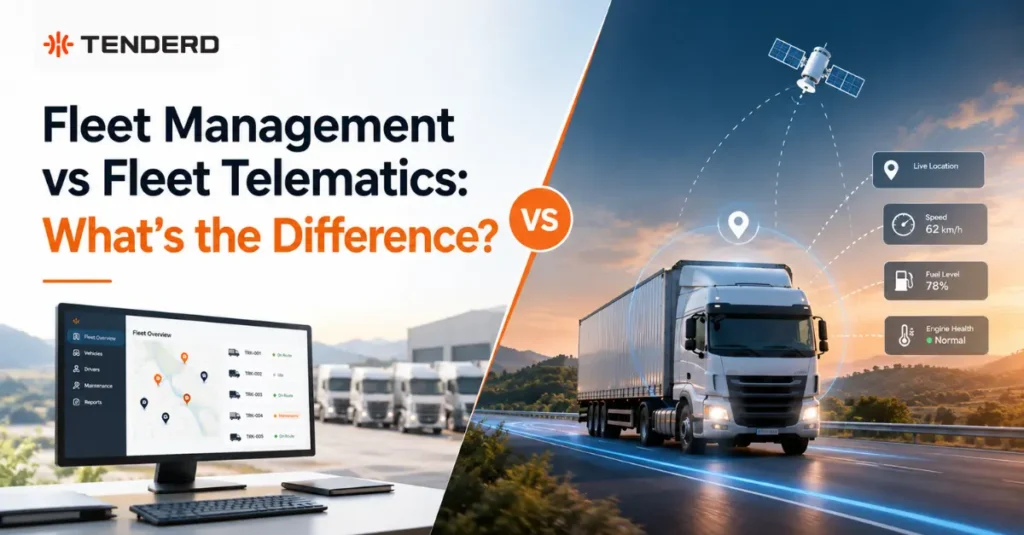
Fleet telematics is the technology that captures and transmits data about a vehicle or machine, primarily its location, movement, and operating status, using GPS and onboard sensors. Fleet management is the broader discipline built on top of that data: using telematics as one input among several, alongside fuel, maintenance, safety, utilization, and logistics information, to plan, monitor, and improve how an entire fleet operates. Telematics answers where an asset is and what it is doing. Fleet management answers what to do about it.
Key Takeaways
- Telematics is a data source. Fleet management is the operational discipline built on top of it. One tells you where a machine is; the other turns that location data, combined with fuel, maintenance, safety, and utilization data, into decisions.
- A GPS dot on a map is not a fleet management strategy. Many UAE operators start with telematics for compliance or theft recovery, then find it does not touch idle time, unplanned maintenance, or unsafe driving on its own.
- In multi-site, mixed-fleet UAE operations, spanning construction, logistics, oil and gas, ports, and mining, telematics data only becomes useful once it is connected to targets, thresholds, and workflows that people actually act on.
- Fleets that connect telematics to a full fleet management platform report measurable outcomes. AD Ports achieved a 30 percent improvement in equipment utilization and a 24 percent decrease in idling time after moving from fragmented tracking to a connected platform.
Introduction
Ask a fleet manager in Dubai or Abu Dhabi whether they have “telematics” and most will say yes. Ask whether they have “fleet management” and the answer gets murkier, because the two terms get used interchangeably in sales conversations, RFPs, and even internal budget requests. That confusion has a cost. A company that buys a GPS tracking device believing it has bought a fleet management system is often surprised, months later, to find it still cannot answer why utilization is flat, why fuel costs keep creeping up, or why a machine broke down without warning.
The distinction matters more in the UAE than in many markets, because fleets here are rarely simple. A single operation might run owned trucks, rented cranes, subcontractor-supplied excavators, and generators across several project sites or ports at once. Telematics can tell you where each of those assets is. It takes fleet management, the layer built on top of that location data, to tell you whether they are being used well, maintained on time, operated safely, and costing what they should.
This article breaks down what each term actually means, how they relate to each other, and what that distinction means in practice for fleet, operations, and equipment managers running mixed fleets across the UAE and wider GCC.
What is Fleet Telematics?
Fleet telematics is the combination of GPS, onboard sensors, and cellular or satellite connectivity that captures data from a vehicle or machine and transmits it to a central system in real time. At its core, telematics answers three questions: where is this asset right now, where has it been, and what is its current operating status, such as ignition on, idle, moving, or offline.
A telematics system typically reports live location on a map, historical movement for a selected date range, and basic engine or diagnostic signals such as speed, battery voltage, or engine temperature. In TENDERD’s platform, this is the role of the Track module: it holds the live position, status, and diagnostic history of every machine, color-coded so a fleet manager can see at a glance which assets are working, idle, switched off, or offline, without opening a single individual record. Geofences, drawn around project sites, camps, or restricted zones, extend that visibility further by logging every time a machine enters or exits a defined area.
Telematics on its own is valuable. It replaces the daily phone call to ask “where is the truck” with a live answer, and it gives operations teams a defensible record when a dispute comes up over hours, location, or an unauthorized site visit. But telematics, by design, is a data layer. It shows what is happening. It does not, by itself, evaluate whether that is good or bad, flag a machine that needs servicing, or explain why fuel consumption spiked on a specific shift.
What is Fleet Management?
Fleet management is the broader operational discipline of planning, monitoring, and improving how an entire fleet, whether vehicles, heavy equipment, or a mix of both, is used, maintained, and accounted for. It takes telematics data as one of several inputs and combines it with fuel consumption, maintenance history, safety events, utilization targets, and logistics records to support real operational decisions.
Where telematics tells you a machine has been idle for six hours, fleet management tells you whether that idle time is within target for that equipment type, which shift it happened on, and what it is costing in fuel and lost productivity. Where telematics logs that a machine crossed a geofence, fleet management connects that crossing to a trip record, a delivery commitment, or a maintenance appointment.
A fleet that only has the first layer has visibility without action. Av fleet that has all three has a system that improves itself over time.
Why the Difference Matters
The practical risk of treating telematics and fleet management as the same thing is that a company ends up paying for, and believing it has, capability it does not actually have. A GPS tracking contract solves theft recovery and basic location visibility. It does not touch idle time, unplanned maintenance costs, unsafe driving patterns, or fuel losses, because those require data from fuel sensors, maintenance schedules, safety events, and utilization targets layered on top of location.
This shows up clearly at scale. When Aramco Mobility set out to manage a fleet of 15,000 mixed assets across Saudi Arabia, the core problem was not a lack of GPS coverage. It was the absence of real-time visibility connected to operational decision-making, combined with heavy reliance on delayed manual reporting, which made it difficult to establish a performance baseline or catch inefficiencies before they compounded. Telematics alone would have shown where those assets were. It would not have closed that gap.
The difference also matters for how a company budgets and evaluates vendors. A telematics-only solution is typically priced and scoped around hardware and basic tracking. A fleet management platform is scoped around outcomes, utilization gains, idle time reduction, maintenance cost control, safety improvement, that a location feed alone cannot deliver.
Key Benefits of Moving from Telematics to Full Fleet Management
- Idle time becomes visible and actionable, not just recorded. Heatmaps and shift-level breakdowns show where machines are running but producing nothing, rather than just logging that they were on.
- Maintenance shifts from reactive to planned. Service schedules trigger on actual hourmeter data instead of a calendar, and every completed job comes back with technician hours and parts cost attached automatically.
- Fuel losses are caught, not just estimated. Every drop and refill is logged per machine and per site tank, with off-site events flagged automatically and replay evidence available to confirm a loss rather than assume one.
- Safety events turn into coaching, not just footage review. Unsafe behavior is scored per operator in real time, with evidence attached, instead of requiring someone to scrub through hours of camera footage after the fact.
- Reporting stops being a monthly scramble. Fuel, emissions, productivity, logistics, and maintenance data are available as standard reports and custom dashboards, so operations, finance, and leadership work from the same numbers.
- Equipment allocation improves. Booking requests are checked against real utilization data rather than a whiteboard, reducing double-booking and idle assets sitting unused on one site while another site requests the same equipment type.
Best Practices for Choosing Between Telematics and Fleet Management
- Start by being honest about what problem you are actually solving. If the goal is theft recovery or basic compliance, telematics alone may be sufficient for now. If the goal is reducing idle time, controlling maintenance cost, or improving safety outcomes, telematics is only the starting point.
- Treat the telematics layer as infrastructure, not the finished product. Accurate geofences, a clean asset record, and reliable location data are the foundation every other capability depends on. Getting that right first pays off across productivity, safety, fuel, and logistics later.
- Set targets before expecting insight. Utilization, idling, and safety data only becomes useful once it is measured against a target defined for your own operation, not a generic industry benchmark.
- Plan for mixed fleets from day one. In the UAE, owned, rented, and subcontractor equipment often work the same site. A platform that only tracks vehicles, or only integrates with one OEM’s equipment, will leave visibility gaps exactly where they matter most.
- Evaluate vendors on outcomes, not device counts. A telematics vendor will talk about GPS accuracy and hardware. A fleet management platform should be able to point to utilization, downtime, and safety outcomes achieved by comparable operations.
- Adoption takes deliberate effort. Moving a team from reading a GPS map to acting on productivity, safety, and maintenance dashboards is a change management exercise, not just a software rollout. Phased implementation and role-specific training matter as much as the platform itself.
- Not every operation needs the same depth immediately. A fleet running a handful of owned vehicles has different needs than one coordinating equipment across multiple subcontractors and project sites. Targets and thresholds should be configured for the operation, not left at a generic default copied from another fleet or region.
Fleet Telematics vs Fleet Management
| Area | Fleet Telematics | Fleet Management |
| Core question answered | Where is the asset and what is it doing | What should be done about it |
| Primary data | GPS location, ignition status, basic diagnostics | Location plus fuel, maintenance, safety, utilization, and logistics data |
| Idle time | Recorded | Measured against a target and flagged |
| Maintenance | Not addressed | Scheduled on actual usage, with cost tracked automatically |
| Fuel | Not addressed | Every drop and refill logged, losses flagged |
| Safety | Not addressed | Behavior scored per operator, with evidence attached |
| Reporting | Raw location and status data | Fuel, emissions, productivity, logistics, and maintenance reports, standard and custom |
| Typical outcome | Visibility | Measurable utilization, safety, and cost improvement |
The Bottom Line
Telematics and fleet management are not competing terms, and they are not interchangeable either. Telematics is the foundation, the GPS, sensors, and connectivity that establish where an asset is and what it is doing. Fleet management is what a company builds on that foundation to actually improve how the fleet performs: less idle time, fewer surprise breakdowns, safer operators, tighter fuel control, and reporting that leadership can trust. For fleets operating across the UAE’s construction sites, ports, logistics corridors, and energy operations, knowing which one you actually have, and which one you need, is the first step toward closing the gap between seeing a problem and fixing it.
If your fleet currently has visibility but not the outcomes to show for it, it may be worth seeing what a connected fleet management platform looks like on your own equipment. Book a demo of TENDERD to see live tracking, productivity, safety, fuel, and maintenance data working together on your fleet’s actual data.
Frequently Asked Questions
Is telematics part of fleet management, or a separate thing?
Telematics is part of fleet management, not a separate category. It is the location and asset-visibility layer that fleet management builds on. A company can have telematics without full fleet management, but not the reverse; fleet management always depends on telematics data as its foundation.
Can a company use telematics without fleet management software?
Yes. Many UAE fleets start with a standalone GPS tracking system for compliance or theft recovery. This gives location visibility but does not address utilization, maintenance planning, fuel loss, or safety scoring, which require fleet management capability layered on top.
Why do fleet management platforms cost more than basic telematics?
Because they are scoped around outcomes rather than hardware. A telematics contract covers devices and location tracking. A fleet management platform covers the productivity, maintenance, fuel, safety, and reporting workflows built on that data, which is what actually reduces cost and improves performance.
Does fleet management replace the need for good telematics hardware?
No. Fleet management depends on accurate telematics data. Poor GPS coverage, unreliable sensors, or badly configured geofences will limit the quality of every insight built on top, regardless of how capable the software layer is.
What should a UAE fleet operator look for when moving from telematics to fleet management?
A platform that unifies location data with fuel, maintenance, safety, utilization, and logistics in one place, supports mixed fleets of owned, rented, and subcontractor equipment, and lets the operation set its own targets rather than relying on generic industry benchmarks.