 Summary
 Summary
Fleet operations visibility means being able to see, at any moment, where every asset is, whether it’s working or idle, how it’s being used, what condition it’s in, and who is operating it. For a new fleet or operations manager, building this visibility is the first job, before any cost-cutting, scheduling change, or performance target is set. Without it, every other decision is a guess dressed up as a plan.
Key Takeaways
- Visibility is not the same as tracking. Knowing where an asset is located tells you almost nothing about whether it’s being used well, maintained on time, or operated safely.
- A new manager inherits gaps, not just equipment. Fragmented spreadsheets, verbal handovers, and inconsistent reporting from the previous setup are usually the real starting point, not a clean slate.
- The first 30 days should be spent auditing, not fixing. Changing processes before you understand the current state usually creates new blind spots instead of closing existing ones.
- A single connected view beats five disconnected reports. Pulling location, utilization, safety, maintenance, and fuel data into one place is what turns raw information into decisions you can act on the same day.
Introduction
Taking over a fleet, whether it’s a construction equipment pool, a logistics fleet, or a mixed set of vehicles and heavy machinery, rarely comes with a clean handover document. More often, a new manager inherits a collection of spreadsheets, a WhatsApp group full of status updates, a maintenance log that’s three weeks out of date, and a general sense that things are “mostly under control.” The gap between that impression and the operational reality is usually the first thing a new manager discovers, and it’s often larger than expected.
This guide walks through what fleet operations visibility actually means, why it matters more in the first few months of a new role than at almost any other point, and how to build it methodically rather than chasing information one phone call at a time.
What is Fleet Operations Visibility?
Fleet operations visibility is the ability to answer basic operational questions about every asset in a fleet without needing to call someone or wait for a report. That includes:
- Where is this asset right now, and has it moved today?
- Is it currently working, idle, or switched off?
- How much has it actually been used this week, compared to how much it’s available?
- When was it last serviced, and when is the next service due?
- Has it been involved in any safety violations or unsafe operating behavior?
- Who is operating it, and is that assignment authorized?
A fleet can have GPS units on every vehicle and still lack visibility, because location alone doesn’t answer most of these questions. Visibility is a broader picture built from location, utilization, safety, maintenance, and fuel or emissions data, brought together in a way that’s easy to scan and act on.
Why Visibility Matters Most in the First 90 Days
A new manager’s early decisions set the tone for everything that follows. Recommending a leaner fleet, pushing back on a rental request, or committing to a delivery timeline all depend on knowing the current state of the fleet with some confidence. Without visibility, those decisions are based on whatever the previous team believed to be true, which may or may not still hold.
There’s also a credibility dimension. A new manager who can point to specific utilization numbers, maintenance backlogs, or idle-time patterns in a conversation with leadership builds trust quickly. One who can only offer impressions and secondhand reports does not, regardless of how capable they actually are.
Finally, problems that go unnoticed in the first few months tend to get blamed on the new manager later, even when they predate the handover. Establishing a documented baseline early protects against that, and gives a clear reference point to measure improvement against.
Common Visibility Gaps a New Manager Inherits
No single source of truth. Location data lives in one system, maintenance records in a spreadsheet, and safety incidents in an inbox somewhere. Answering a simple question means checking three places and hoping they agree.
Utilization is assumed, not measured. Equipment is believed to be busy because it’s assigned to a project, not because anyone has confirmed it’s actually running and producing work.
Subcontractor or third-party equipment is a blind spot. When assets are supplied by external parties rather than owned outright, tracking and reporting on that equipment is often inconsistent or missing entirely, even though it counts toward the same operational risk.
Maintenance is reactive by default. Service history exists, but nobody is actively watching for equipment approaching a service interval until it breaks down.
Safety data is incident-driven, not pattern-driven. Violations get logged after something goes wrong, rather than surfaced early enough to prevent it.
Reports describe the past, not the present. Monthly or weekly reports tell a manager what happened last period, by which point the operational decision that mattered has already been made without the right information.
A 30-60-90 Day Framework for Building Visibility
Days 1 to 30: Audit, don’t fix. Inventory every asset the fleet is responsible for, including subcontractor-supplied equipment. Identify which assets are already tracked in some form and which are not. Pull whatever utilization, maintenance, and safety data currently exists, even if it’s fragmented, and note where the gaps are rather than trying to close them yet.
Days 31 to 60: Consolidate the picture. Bring location, utilization, maintenance, and safety data into a single view wherever possible. This is where a connected fleet management platform earns its place: instead of a manager checking a tracking system, a maintenance spreadsheet, and a safety log separately, a unified dashboard puts all three side by side, scoped to the same fleet and the same time period.
Days 61 to 90: Set targets and start measuring against them. Once the baseline is visible, define realistic utilization, idle-time, and maintenance-compliance targets for each equipment category. From this point forward, performance is measured against a number the manager set deliberately, not against a vague sense of what “normal” used to look like.
How TENDERD Supports Each Stage
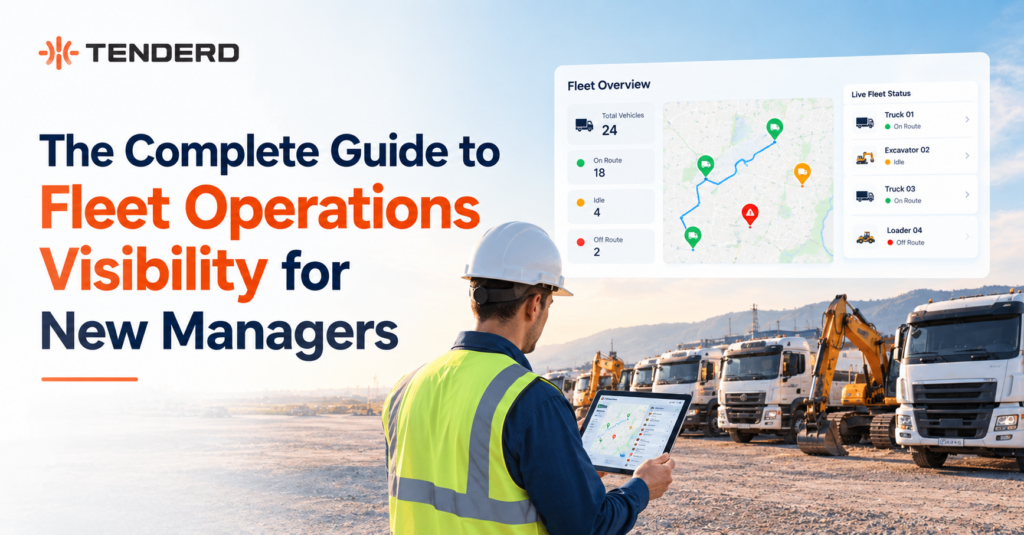
Building the baseline (Track module). TENDERD’s Track module gives every asset, owned or subcontractor-supplied, a single record covering live location, working and idle status, operating hours, and history. Instead of assembling that picture from separate systems, a new manager can see the whole fleet’s current status on one map, color-coded by whether each asset is working, idle, switched off, or offline.
Consolidating the view (Nexus). TENDERD’s Nexus module acts as a unified command center that pulls productivity, utilization, and idling emissions into one screen, benchmarked against targets the manager sets rather than generic industry averages. Instead of checking five reports to understand fleet health, a manager can open one screen, see which equipment categories need attention, and drill down from the whole fleet to a single machine in a few clicks.
Closing the utilization gap (Productivity module). Once visibility exists, TENDERD’s Productivity module shows how much work each machine actually did against how much of the day it was available, separated by shift, so a manager can tell the difference between equipment that’s genuinely busy and equipment that’s simply assigned to a project but sitting idle.
Catching maintenance before it becomes downtime (Maintenance module). Rather than relying on a static service schedule, TENDERD’s Maintenance module tracks equipment condition and usage to flag assets approaching a service interval, shifting maintenance from reactive to planned.
Making safety visible before an incident (Safety module). TENDERD’s Safety module surfaces unsafe operating behavior and near-miss patterns as they happen, rather than relying on incident reports filed after the fact, giving a new manager an early view of risk rather than a record of what already went wrong.
Extending visibility to fuel and emissions (Fuel and Emissions modules). For fleets where fuel cost or emissions reporting matters, these modules extend the same visibility principle to consumption and idling emissions, so fuel waste and environmental reporting aren’t a separate exercise from operational tracking.
Coordinating shared or rented equipment (Bookings module). Where equipment is shared across projects or teams, the Bookings module gives a manager visibility into who has an asset, for how long, and whether it’s likely to be free when the next project needs it, reducing the redundant rentals and double-booked equipment that fragmented visibility tends to create.
Because all of these modules read from the same underlying asset and location data, a manager doesn’t need to reconcile figures across separate tools. A utilization number seen in Nexus matches the record behind it in Track, which is the kind of consistency that’s difficult to get from a collection of point solutions stitched together after the fact.
Challenges and Limitations
Building visibility is not purely a software rollout, and it’s worth being honest about where the friction shows up.
Adoption takes longer than installation. Getting operators, dispatchers, and site supervisors to actually use a new system, rather than falling back on phone calls and paper logs, requires deliberate change management, not just access to a dashboard.
Data quality depends on setup. Incomplete geofences, missing operator assignments, or inconsistent tagging of subcontractor equipment can undermine confidence in the system even when the underlying platform is sound.
Visibility doesn’t fix a process on its own. Seeing that fifteen assets are sitting idle is useful only if there’s a clear next step for reallocating or addressing them. Visibility surfaces problems; someone still has to act on what it shows.
Not every gap needs the same urgency. A new manager can be tempted to fix everything discovered during the audit at once. It’s usually more effective to prioritize the gaps with the clearest cost or safety impact first.
Best Practices for New Managers
Resist the urge to change things in week one. Understand the current state fully before adjusting schedules, headcount, or vendor relationships based on early impressions.
Ask for data, not summaries, during handover. A verbal assurance that “utilization is fine” is not the same as seeing the actual numbers behind that statement.
Set your own targets rather than inheriting old ones. Previous benchmarks may reflect outdated assumptions about the fleet’s size, mix, or workload.
Make the fleet’s real-time status visible to your team, not just to yourself. A dashboard that only the manager checks doesn’t change day-to-day behavior. Sharing the same view with dispatchers and supervisors builds shared accountability.
Revisit the baseline periodically. A fleet’s composition, workload, and risk profile change over time. What counted as good utilization six months ago may not still apply.
The Bottom Line
A new fleet or operations manager’s most valuable early asset isn’t a plan, it’s an accurate picture of what’s actually happening across the fleet right now. Building that picture takes deliberate effort in the first few months, but it pays off in every decision that follows, from setting realistic targets to defending budget requests with real numbers instead of impressions.
If you’re stepping into a fleet without a clear, unified view of your equipment, book a demo of TENDERD to see how tracking, utilization, maintenance, and safety data can come together in one view from day one.
Frequently Asked Questions
What's the difference between fleet tracking and fleet visibility?
Tracking tells you where an asset is. Visibility includes tracking but also covers utilization, maintenance status, safety behavior, and fuel or emissions data, giving a complete operational picture rather than just a location on a map.
How long does it take to build real visibility into a fleet?
A reasonable baseline can usually be established within the first 60 to 90 days, though the exact timeline depends on how fragmented the existing data is and how much of the fleet is already instrumented in some form.
Do I need visibility into subcontractor or rented equipment too?
Yes. Equipment supplied by third parties still carries the same operational and safety risk, and gaps in visibility there are often the most costly because they're the easiest to overlook.
What should I prioritize first: tracking, utilization, maintenance, or safety?
Start with basic tracking and asset inventory, since every other layer depends on knowing what equipment exists and where it is. From there, utilization and safety typically surface the most urgent issues, with maintenance visibility close behind.
Can visibility alone reduce fleet costs?
Visibility itself doesn't reduce costs, but it reveals where the costs are coming from, such as idle equipment, unnecessary rentals, or reactive maintenance, so a manager can act on the actual source of the problem rather than making across-the-board cuts.