 Summary
 Summary
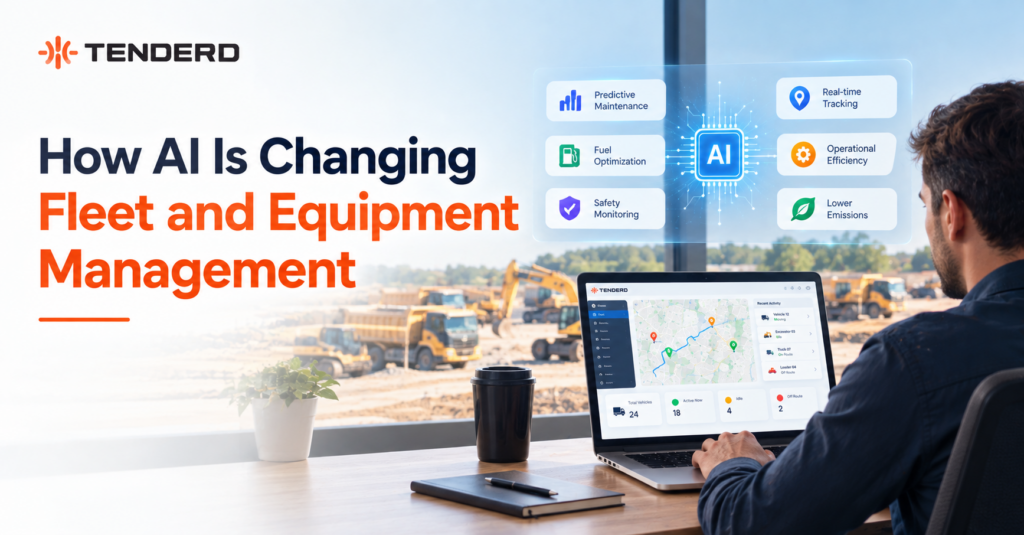
AI is starting to do more than create reports. It can now spot problems in your equipment data, warn you before something breaks down, and call the right person when something needs attention. The real change isn’t that AI exists. It’s the move from a dashboard someone has to remember to check, to a system that actually gets a problem in front of someone who can fix it.
Key Takeaways
- The useful question isn’t whether AI exists. It’s what AI actually does with your equipment’s data, today.
- The most proven use of AI so far is catching equipment problems before they cause a breakdown.
- The newer and more useful step is AI deciding, on its own, that something matters enough to call a person about it.
- On the Aramco SPARK project, AI-based monitoring helped cut idling emissions by 38 percent over four months, across 50 pieces of equipment.
Introduction
There’s a lot being written about AI and fleet management right now, most of it full of big numbers and bold claims. Very little of it explains what actually changes for someone running cranes, generators, and trucks across a UAE construction site or a Saudi energy project.
The real answer is simpler than the hype suggests. AI helps in three ways: it spots patterns in equipment data that a person would likely miss, it uses those patterns to warn you about a problem before it happens, and, at its best, it decides something is serious enough to call a person directly. This article looks at what that means in practice, using real examples, and where AI still falls short of what some people claim it can do.
What AI Actually Does
AI in fleet and equipment management comes down to three things.
It spots patterns: a single piece of equipment produces a lot of data: hours run, fuel used, location, and warning signals. No one has time to check all of it by hand. AI’s job is to turn that data into something a person can act on. That’s the idea behind TENDERD’s Nexus dashboard: it compares every piece of equipment against the targets you set, and flags each one as Critical, Needs Attention, or Outperforming, so you always know where to look first.
It predicts problems: instead of just showing where things stand today, AI looks at how a number is trending and predicts what’s likely to happen next. A few days of rising engine temperature, for example, can be an early sign that a part is about to fail.
It takes action: this is the newest step, and one most companies haven’t built yet. Instead of leaving a warning on a dashboard for someone to notice, the system decides the warning matters enough to call someone directly. TENDERD’s AI Agent does exactly this.
Predictive Maintenance: Fixing Problems Before They Happen
Of the three, predicting problems has been around the longest, and maintenance is where it’s used most. Normally, equipment gets serviced on a fixed schedule, say every 250 hours, whether it needs it or not. AI-based maintenance looks at how the equipment is actually performing and asks a better question: is it going to break down before the next scheduled service?
TENDERD’s Predictive Maintenance Agent does exactly this. It watches how an asset’s condition is trending over time, then checks that against its service history before deciding anything. If it looks like a part is going to fail before the next scheduled visit, it calls the maintenance manager directly, so the equipment can be brought in early, before it breaks down rather than after.
That difference, fixing something because it’s starting to fail rather than because the calendar says so, matters most for the equipment you can’t afford to lose without warning: a crane mid-lift, a generator powering a site, a compressor on a live production line.
Using Data to Cut Costs and Emissions
Predicting problems isn’t just useful for maintenance. The same idea, turning data into an early warning, also helps with how equipment is used and what it costs to run.
On the Aramco SPARK project in King Salman Energy Park, TENDERD used sensors and a machine learning model to track equipment use and emissions in real time, instead of waiting for a monthly report. That let the project team catch and fix idling as it happened, rather than after the fact. Over four months and across 50 pieces of equipment, this helped cut idling emissions by 38 percent.
At ALEC’s Abu Dhabi SeaWorld project, coordinating equipment across 17 subcontractors made it hard to see what was sitting idle and what was being requested unnecessarily. TENDERD gave ALEC’s team a clear, real-time view of how equipment was performing against its targets, which helped them move underused machines to where they were actually needed. Over the course of the project, this led to a 25 percent improvement in equipment use and a 34 percent drop in downtime.
Both figures come from TENDERD’s own project records for these deployments, as previously published in TENDERD content. No third-party or unverified statistics are used in this article.
Safety: Acting Before Something Goes Wrong
Safety is where the shift from watching to acting really shows. In the past, checking on safety often meant reviewing camera footage after something had already gone wrong. AI flips that around: instead of reviewing footage after an incident, it watches behavior and site data as it happens, and raises a flag before an incident occurs.
ALEC used this approach on its project, analyzing data from multiple sources to catch hazards early and send instant alerts, giving site teams time to step in before an accident happened. On TENDERD’s Productivity module, any figure captured through an AI camera can also be checked against the actual footage, so it isn’t just a number a manager has to take on faith.
TENDERD’s Driver Safety Agent takes this a step further. It watches how someone is driving, and if it sees a repeated pattern of unsafe behavior, not just one mistake, it calls the supervisor first. The supervisor can review what the agent found, ask questions, and has to approve before the agent calls the driver directly for a coaching conversation. Every call is recorded, so there’s a clear record of what happened and why.
AI Agents: When the System Picks Up the Phone
The real difference between a system that just tells you something and one that gets something done is whether it acts on its own. TENDERD’s AI Agent is built around that idea. Five agents run in the background, each watching a different part of the operation, and each one calling the right person when something matters.
- Driver Safety Agent: watches driving behavior and calls the supervisor if it sees a repeated unsafe pattern. The driver is only called after the supervisor approves it.
- Fuel Monitoring Agent: watches for fuel being wasted through idling, and calls the fleet manager when it finds a pattern worth flagging.
- Equipment Reassignment Agent: notices when a machine has sat unused for several days, and calls the operations manager to suggest moving it somewhere it’s needed.
- Predictive Maintenance Agent: spots equipment likely to fail before its next scheduled service, and calls the maintenance manager ahead of time.
- Welding Productivity Agent: at the end of a shift, works out who welded the most and calls to let them know, the one agent that delivers good news instead of a warning.
None of these agents act on a single event. They wait until something happens repeatedly before calling anyone, which is what makes the call worth answering. And none of them make changes on their own. They tell a person what they’ve found, and the person decides what to do next.
See how TENDERD’s five AI Agents watch your fleet and decide when a call is worth making. Book a demo of TENDERD.
Why this Matters More for UAE and GCC Fleets
Most talk about AI and fleet management pictures a single delivery van or truck moving between two points. That’s not how most UAE or GCC operations work. A single project might involve owned trucks, rented cranes, equipment supplied by several subcontractors, and generators, spread across multiple sites at once.
At that scale, no team can keep track of everything by hand, and missing something, an idle machine, a part about to fail, an unsafe driving pattern, costs more because it’s harder to spot in the first place. This is exactly where AI helps most: not just noticing problems, but making sure the right person hears about them in time to act.
What AI Doesn’t Do
It’s worth being upfront about the limits, because overselling AI makes it harder to trust the parts that actually work. Right now, AI agents recommend and alert. They don’t reassign equipment, approve maintenance, or take a driver off the road on their own. Predictions are based on patterns in real data, not guarantees, which is why TENDERD’s Predictive Maintenance Agent checks its own prediction against an asset’s actual service history before acting on it.
Fully self-driving equipment, or machines coordinating with each other without any person involved, aren’t part of what’s described here. If a vendor claims otherwise, it’s worth asking them to point to a real, working example.
The Bottom Line
AI in fleet and equipment management is less dramatic than the hype, and more useful. It isn’t self-driving trucks or a fully automatic fleet. It’s a system that reads the data your equipment already produces, catches what a person might miss, warns you before a small problem becomes an expensive one, and, at its best, picks up the phone to tell the right person. For UAE and GCC operations running mixed equipment across multiple sites, that’s the real value: turning a report someone might read into a call someone actually answers.
If your equipment’s warnings are piling up somewhere no one checks, it might be worth seeing what happens when they turn into a phone call instead. Book a demo of TENDERD to see the AI Agent working with your own fleet’s data.
Frequently Asked Questions
Is AI in fleet management just predictive maintenance?
No. Predicting failures is one part of it. AI is also used to catch safety issues in real time, track productivity and emissions, and, in TENDERD's case, decide on its own when to call someone about a problem.
Can AI actually contact someone directly, or does it just create alerts?
Both exist, and the difference matters. Many systems stop at a dashboard alert someone has to remember to check. TENDERD's AI Agent goes further: when something is confirmed, it calls the right person directly, and for safety issues, it checks with a supervisor first.
Does this work for heavy equipment, not just trucks?
Yes. The same approach, spotting patterns and predicting problems, works for cranes, generators, compressors, and other heavy equipment, as long as there's enough data from that equipment to learn from.
How accurate are AI predictions?
It depends on how much history there is for that piece of equipment. TENDERD's Predictive Maintenance Agent checks its prediction against the equipment's actual service record before acting on it, rather than relying on a single reading.
Is AI replacing fleet managers and maintenance teams?
No. TENDERD's AI Agents only decide that a person should know about something, and tell them. A manager or supervisor still makes the actual call on what to do next.