 Summary
 Summary
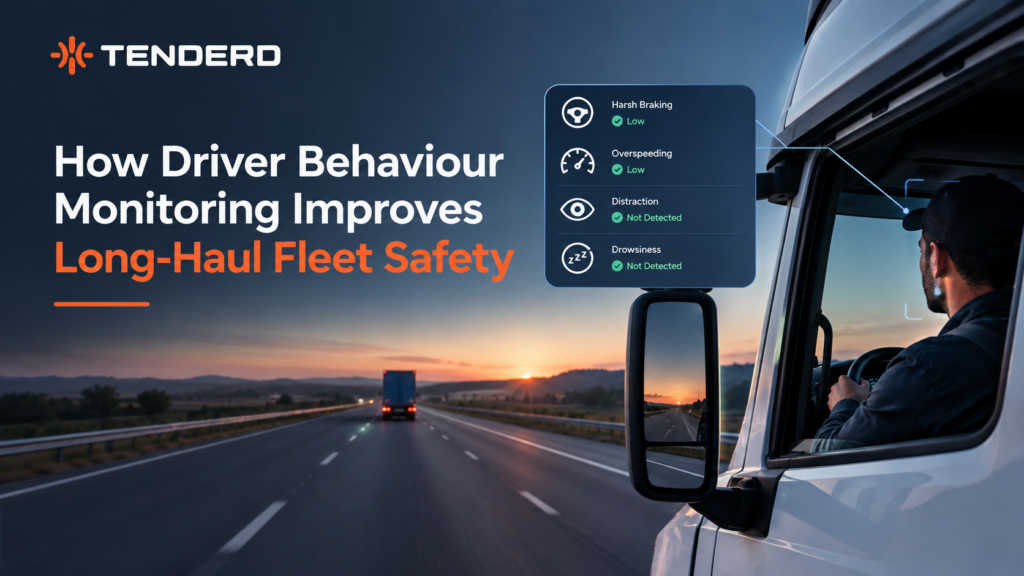
Driver behaviour monitoring improves long-haul fleet safety by making the hours a truck spends out of sight measurable. Telematics and in-cab cameras detect fatigue, distraction, phone use, speeding, harsh driving and unsafe following distances as they happen, alert the right person, and attach evidence to each event. Over time, those events build into a scored record for every driver, so fleets can coach the specific behaviours behind long-haul crashes instead of reacting after one.
Key Takeaways
- Long-haul risk builds up where nobody can see it. Fatigue, monotony and highway speed accumulate over hours, far from any supervisor. Monitoring closes that visibility gap while the trip is still under way.
- The strongest programmes watch both the vehicle and the driver. Telematics shows how the truck is being driven; a driver-facing camera shows whether the person behind the wheel is alert, attentive and belted.
- Evidence and scoring turn alerts into coaching. A short video clip and a Safety Score trended against the fleet average give a supervisor something specific to discuss, rather than an impression.
- In the GCC, route timing matters as much as route length. Peak-hour truck restrictions push a large share of heavy-vehicle movement into off-peak and overnight windows, which is exactly when fatigue risk is highest.
Introduction
On a long-haul run, a supervisor usually sees two moments: the truck leaving the yard and the truck arriving at its destination. Everything in between, the eighth hour behind the wheel, the stretch of empty highway at 3 a.m., the phone call taken at 100 km/h, happens without anyone watching.
That gap is where most long-haul safety programmes are weakest. Training, rest rules and pre-trip checks all happen before the wheels turn. Once the truck is on the road, the fleet is relying on the driver’s judgement under exactly the conditions that erode it.
Driver behaviour monitoring changes that by turning the trip itself into observable data. This article explains what it is, how it works on a long-haul truck, which risks it addresses, how it applies to fleets operating in the UAE and wider GCC, and where its limits are.
What is Driver Behaviour Monitoring?
Driver behaviour monitoring is the continuous, automated detection of unsafe driving and unsafe driver conditions using sensors fitted to the vehicle. It combines two data streams:
- How the vehicle is being driven: speed, harsh acceleration, harsh braking, harsh cornering and lane departures, captured through telematics.
- What the driver is doing: signs of fatigue, distraction, phone use, smoking or eating, and seatbelt use, captured through a driver-facing AI camera.
Many systems add a third stream from road-facing cameras and proximity sensors, which detect collision risk such as closing too fast on the vehicle ahead or a pedestrian in the truck’s path.
This is different from GPS tracking. Tracking tells you where a truck is. Behaviour monitoring tells you how it is being driven and whether the driver is fit to be driving it at that moment.
How Driver Behaviour Monitoring Works on a Long-Haul Truck
In TENDERD’s Safety module, monitoring runs as a continuous loop with five stages.
- Sense. Each enrolled vehicle carries a combination of smart devices. Telematics provides location, speed and distance. A dashcam watches the driver and the road. A Proximity Warning and Awareness System (PWAS) detects collision risk. In-vehicle monitoring (IVMS) adds signals such as a physical seatbelt sensor and power-disconnect tampering.
- Detect. Every signal is checked against a configurable rule. Each rule has its own speed threshold, sensitivity, trigger hold time (how long a condition must persist to count) and alarm interval (the cooldown before a repeat alert). A driver glancing at a mirror is not distraction; eyes off the road for an extended period is.
- Classify. Each event is tagged by category (Driving, Zone, Operator, Proximity, Engine or Crash), marked Critical or Non-critical, and linked to the specific vehicle, driver and location.
- Surface. The violation appears on the fleet dashboard and on both the vehicle’s and the driver’s profiles. Depending on configuration, it can trigger a real-time notification and capture a photo or a video clip covering five seconds before and five seconds after the event.
- Tune. Administrators adjust rules by vehicle type, and override them for a specific vehicle or a geofenced location such as a depot or a customer yard with a lower speed limit.
The detection itself is automatic. Nobody has to scroll through hours of dashcam footage to find the moment that matters.
Why Long-Haul Routes Need Driver Monitoring More Than Most
Long-haul driving concentrates the conditions that make crashes more likely and more severe.
Fatigue accumulates. Long shifts, irregular sleep and monotonous highway driving wear down alertness gradually, often without the driver noticing. FMCSA’s fact sheet on hours-of-service, drawing on the Large Truck Crash Causation Study, reports that 13 percent of commercial vehicle drivers were considered fatigued at the time of a serious crash.
Speed is a truck-driver problem. The same study found that fatigue was coded twice as often for passenger vehicle drivers, while speeding was coded more often for truck drivers. On open intercity highways, speed creep over long, empty stretches is easy to fall into and hard to self-correct.
Mass and stopping distance multiply consequences. A loaded tractor-trailer needs far more distance to stop than a car. Following too closely or reacting a second late carries a much higher cost, which is why forward collision and headway warnings matter so much on this kind of route.
Nobody is watching. On a construction site, a supervisor may spot unsafe behaviour. On a 600 km run, the driver is alone for the entire shift. Without monitoring, the first sign of a problem is often the incident itself.
Key Benefits of Driver Behaviour Monitoring for Long-Haul Fleets
Catching fatigue and distraction while the trip is still under way
A driver-facing camera can detect the physical signs of drowsiness, including drooping eyes, head nodding and yawning, as well as eyes off the road, phone use, smoking or eating, an unfastened seatbelt, and a blocked camera. Additional drowsiness signals such as abnormal blink patterns and microsleep can be enabled where a fleet wants tighter coverage.
The value on a long-haul route is timing. A fatigue event flagged in the fourth hour of a night run gives dispatch the chance to call the driver and arrange a stop before the ninth hour, rather than reading about it in a weekly report. In TENDERD deployments, real-time detection of speeding, fatigue and distracted driving has been validated with operator-facing alerts alongside the HSE dashboard, so the warning reaches the cab as well as the control room.
Controlling speed and following distance on open highways
Telematics flags overspeeding and harsh driving events on every leg. Where a fleet wants to separate occasional overspeeding from sustained, excessive speed, reckless driving rules can be switched on, including a version specifically for excessive speed outside geofenced zones, which suits open-highway driving.
Road-facing detection covers the collision risks that matter most on highways: forward collision warnings, headway monitoring (high speed combined with a short following distance), lane departure warnings and pedestrian collision warnings.
Coaching from evidence instead of anecdote
Every driver has a Safety Score, trended over time and benchmarked against the fleet average and the best-performing driver. Alongside it sits the driver’s full violation history and, where evidence capture is enabled, the image or clip for each event.
That changes the coaching conversation. “You’ve been braking hard” is easy to dispute. A clip of three harsh braking events on the same stretch of highway, next to a score that has dropped below the fleet average for a month, is not. The conversation moves from blame to a specific, fixable pattern.
Connecting behaviour to the route
In TENDERD’s Logistics module, driving violations are logged against each journey leg of a trip and plotted on the route map with GPS coordinates. A transport manager reviewing a completed trip can see not just that a delivery ran late, but where on the route the harsh braking or overspeeding happened. Repeated events at the same location often point to a route problem, such as a dangerous junction or an unrealistic schedule, rather than a single driver.
Escalating patterns that keep recurring
Some behaviours do not change after one alert. TENDERD’s AI Agent includes a Driver Safety Agent that watches for repeated critical violations rather than reacting to a single event. When a pattern is established, it calls the supervisor, presents the evidence and answers questions. Only after the supervisor approves does it place a coaching call to the driver. Every call is recorded and transcribed, so the intervention itself becomes part of the safety record.
Building a defensible safety record
Each violation carries a timestamp, location, speed at the moment of the event, and optional image or video evidence. For fleets bidding on contracts with safety questionnaires, answering client HSE audits or discussing insurance renewals, that record shows not only that unsafe behaviour was detected, but what the fleet did about it.
Long-Haul Fleet Safety in the UAE and GCC
Fleets in the UAE and wider GCC face a particular timing problem. To reduce collisions between trucks and private cars at peak hours, authorities restrict heavy-vehicle movement during the busiest periods. In Dubai, commercial vehicles are restricted during three main peak periods (6:30 to 8:30 a.m., 1:00 to 3:00 p.m. and 5:30 to 8:00 p.m.) and are prohibited from major roads including Sheikh Zayed Road and Al Khail Road during those hours.
The safety logic behind these restrictions is sound, but it has a side effect. Truck movement concentrates into off-peak and overnight windows. Dubai RTA’s own heavy truck handbook advises drivers to make long trips during the hours they would normally be awake, while acknowledging this is not always possible because traffic restrictions limit heavy vehicles to night driving in some parts of Dubai. For a long-haul fleet, this means a significant share of driving happens exactly when the body expects to sleep.
Infrastructure is catching up. RTA has been building 19 truck rest areas along roads including Sheikh Mohammed bin Zayed Road, Emirates Road, Dubai-Hatta Road and Dubai-Al Ain Road, with space for around 1,000 trucks and heavy vehicles. Rest areas help, but they only work if drivers stop before fatigue sets in. Monitoring is what tells a fleet when that is not happening.
Two practical implications follow for GCC fleets:
- Review safety by shift, not only by driver. Filtering violations by shift shows whether fatigue and distraction events cluster in overnight windows. If they do, the fix may sit in scheduling rather than coaching.
- Treat heavy-equipment haulage as its own risk profile. Construction and oil and gas contractors regularly move excavators, compressors and other heavy equipment between project sites on flatbeds and trailers. A loaded trailer on an intercity highway needs different thresholds from a pickup running between site offices. In the Safety module, each machine type, such as trailer, flatbed, rigid truck or sedan, carries its own rule set.
The volume of risky events is also usually higher than fleets expect. In a TENDERD pilot across 35 monitored assets, including cargo trucks, the baseline was 59 safety alerts per truck, per week, before any targets had been set. That baseline gave the operator real data to hold safety briefings around, and a starting point to measure improvement against.
What Driver Behaviour Monitoring Does Not Do
Monitoring is a powerful safety layer, but it is not the whole safety programme. Being clear about its limits helps fleets deploy it well.
It detects fatigue; it does not prevent it. A camera identifies the signs of drowsiness once they appear. Preventing fatigue still depends on realistic schedules, adequate rest between shifts and drivers who feel able to stop.
It does not replace rest planning. Deciding when drivers rest, and building schedules that allow it, remains a dispatch and management responsibility.
Alerts without a response change nothing. A system that generates hundreds of alerts a week and routes them all to a weekly digest will not make anyone safer. The response process matters as much as the detection. (We cover this in detail in What Happens When Fleet Safety Alerts Go Unanswered?)
Poorly tuned rules create noise. Thresholds set too tightly produce false positives, and drivers and supervisors quickly learn to ignore them. Tuning by vehicle type and location is part of the deployment, not an afterthought.
Driver acceptance has to be earned. A driver-facing camera can feel like surveillance if it arrives without explanation. Fleets that involve drivers early, explain what is detected and why, and use the data for coaching rather than punishment tend to get better adoption. Direct engagement with field operators was one of the lessons learned in TENDERD’s own pilot deployments.
Best Practices for Rolling Out Driver Monitoring on a Long-Haul Fleet
- Start with the behaviours behind serious crashes. Mark fatigue, distracted driving, phone use, forward collision warnings and headway warnings as Critical, and route them to real-time notification. Leave lower-severity, high-frequency events in a weekly summary.
- Configure by vehicle type. Set separate thresholds for tractor-trailers, rigid trucks and light vehicles, then use geofence overrides for depots, yards and customer sites.
- Turn on evidence capture for critical events. A short clip before and after the trigger is what makes a coaching conversation specific and hard to dispute.
- Compare drivers on a normalised basis. Long-haul drivers cover more kilometres, so they will record more events. Look at violations per 100 km rather than raw totals.
- Review by shift and by route. Overnight clusters point to scheduling pressure. Repeated events at the same location point to a route problem.
- Coach on trends, not single events. One harsh braking event is a data point. A Safety Score that has been falling against the fleet average for three weeks is a signal worth acting on.
- Bring drivers into the process. Explain the system before it goes live, show drivers their own scores, and recognise improvement as well as flagging problems.
| Aspect | GPS tracking | Driver behaviour monitoring |
| Main question answered | Where is the truck? | How is it being driven, and is the driver fit to drive? |
| Typical data | Location, speed, route history, stops | Harsh driving, speeding, fatigue, distraction, phone use, seatbelt, collision risk |
| Main users | Dispatch, operations, customer service | HSE, fleet safety, supervisors |
| Evidence | Location trail | Event-linked images and video clips |
| Outcome | Visibility and delivery control | Fewer unsafe behaviours through detection and coaching |
The two work best together. Tracking places each event on the map; behaviour monitoring explains what happened there.
Conclusion
Long-haul safety has always depended on what happens when nobody is watching. Driver behaviour monitoring does not remove the need for good scheduling, rest and training, but it closes the visibility gap in between: it detects fatigue, distraction and unsafe driving as they happen, gives supervisors evidence to act on, and builds a record that shows whether the fleet is actually getting safer.
For fleets in the UAE and GCC, where route restrictions push much of the driving into overnight hours, that visibility is especially valuable. If you want to see how your fleet’s drivers perform across every shift and every leg, book a demo of TENDERD Safety and see critical violation routing, evidence capture and driver Safety Scoring on your own fleet data.
Frequently Asked Questions
Can driver behaviour monitoring detect fatigue?
Yes. Driver-facing AI cameras detect physical signs of fatigue such as drooping eyes, head nodding and yawning, and can be configured to flag additional drowsiness signals such as abnormal blinking and microsleep. The system detects signs of fatigue as they appear; preventing fatigue still depends on scheduling and rest.
What behaviours are monitored on a long-haul truck?
Typically overspeeding, harsh acceleration, harsh braking, harsh cornering, lane departures, fatigue, distraction, phone use, smoking or eating, seatbelt use, camera tampering, and collision risks such as forward collision and headway warnings.
How do you stop driver monitoring from producing too many alerts?
Classify violations by severity, send only critical events in real time, and tune thresholds by vehicle type and location using sensitivity, hold time and alarm interval settings. Well-tuned rules produce fewer, more meaningful alerts.
Is driver behaviour monitoring the same as a dashcam?
No. A dashcam records video. A monitoring system analyses camera and telematics data automatically, classifies each event, links it to a driver and vehicle, scores the driver over time, and routes alerts to the right person.
How does a driver Safety Score work?
A Safety Score summarises a driver's overall safety performance from their recorded violations. In TENDERD's Safety module, it is trended over time and benchmarked against the fleet average and the best-performing driver, which makes it a practical basis for coaching.
Do drivers accept in-cab cameras?
Acceptance improves when drivers understand what is monitored and why, can see their own data, and experience the system as coaching rather than punishment. Involving drivers before rollout makes a noticeable difference.