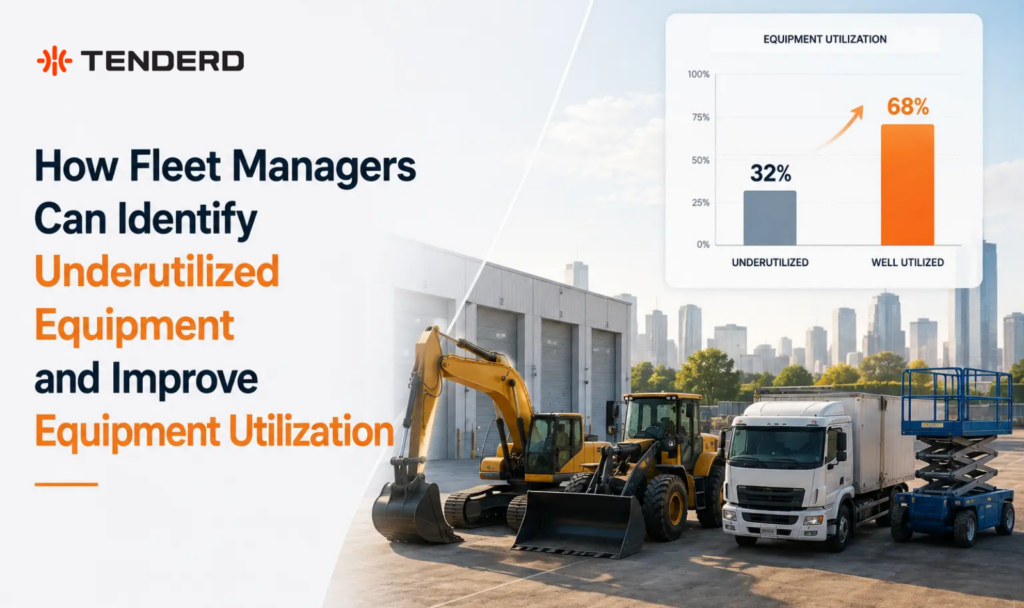
 TL;DR: One-Minute Brief
 TL;DR: One-Minute Brief
Underutilized equipment is any machine generating less operating time or output than its ongoing cost justifies, even while it technically stays part of active operations. Fleet managers identify it by comparing an asset’s actual utilization against the target set for its equipment category, then watching for utilization that stays below that target for several consecutive days rather than a single quiet shift. TENDERD’s Productivity module tracks this automatically for every asset type, and its Equipment Reassignment Agent alerts the operations manager as soon as that pattern is confirmed, so the asset can be redeployed before the idle time compounds.
Key Takeaways
- Utilization means something different for each equipment type. A crane, a generator, and a road vehicle each need a different measure of “being used,”
which is why TENDERD’s Productivity module tracks equipment-specific metrics instead of one generic formula. - A single idle day does not make an asset underutilized. The signal worth acting on is utilization staying below its category target for several consecutive days.
- TENDERD’s Equipment Reassignment Agent watches for exactly that pattern and, once it is confirmed, calls the operations manager directly so a redeployment decision can be made while the opportunity is still live.
- On ALEC’s SeaWorld Abu Dhabi project, centralizing utilization data across 130 monitored assets and 17 subcontractors delivered a 25% improvement in equipment utilization and a 34% reduction in equipment downtime.
Introduction
Every asset on a fleet roster accrues cost whether it moves or not: insurance, depreciation, storage, and a baseline of preventive maintenance. A machine that sits idle for weeks between jobs is still costing money the entire time, it is just costing money quietly, which is why underutilization is easy to miss until someone goes looking for it. The challenge for most fleet and equipment managers is not a lack of data. It is that utilization data usually sits scattered across sites, subcontractors, and spreadsheets, with no single view that says clearly which machines are earning their keep and which ones are not. This article walks through how to define underutilization correctly for different equipment types, how TENDERD’s Productivity module surfaces it automatically, and how the Equipment Reassignment Agent turns that visibility into a phone call and a decision, rather than a report nobody opens.
What Counts as Underutilized Equipment?
An asset is underutilized when its actual usage falls short of the level needed to justify keeping it on the fleet, and that shortfall holds over a meaningful stretch of time rather than one slow week. It is not the same as an asset being broken or off-site for a valid reason. A generator held in reserve for emergency backup, or a paver waiting for the next phase of a project to start, is doing its job even while it sits still. What separates a genuinely underutilized machine from a legitimately idle one is a repeated pattern with no operational explanation attached to it.
Why Utilization Isn’t One Number
One of the most common mistakes in this kind of analysis is applying a single utilization formula to every asset on the fleet. A pickup truck and a boom loader do fundamentally different kinds of work, so measuring them the same way hides more than it reveals. TENDERD’s Productivity module is built around this idea: utilization and productivity are not one fixed measure, they adapt to the equipment being tracked.
A crane’s utilization is read from ignition time and idling with no payload, while its productivity is measured by engagement time on the hook. A generator is judged on running hours against standby hours and load percentage, with output measured in power generated over time. An excavator’s utilization comes from bucket and boom activation against idle hours, and its productivity is the volume of material moved per hour. A dump truck is measured on payload trips and tipping activity, with productivity expressed as tons transported per day. Road vehicles are measured more simply, by the proportion of ignition time spent actually moving. The module carries a defined metric pair for every equipment category on the fleet, so a fleet manager comparing a crane and a road vehicle is comparing the right thing for each, not forcing both into the same formula.
How the Productivity Module Surfaces Idle Equipment
Spotting underutilization starts with visibility, and TENDERD’s Productivity module is built to make it visible at three levels. The Dashboard gives a fleet-wide view: total utilization and ignition hours, a daily utilization-versus-idling trend, and a horizontal ranking of every machine category against its target, color-coded above or below target so a fleet manager does not have to interpret a raw percentage. The Machines tab lists every enrolled asset with its utilization, productivity, and productivity per day in a sortable, filterable table, and drills down into any single machine’s day, hour by hour, showing exactly when it was moving and when it was not. The Graphs tab is built for scanning a large mixed fleet quickly, showing an hourly utilization and idling bar chart for every machine, sorted so the least-utilized assets surface first.
Together, these views distinguish an engine that is running from a machine that is actually working, which is the difference that matters when deciding whether an asset deserves to stay on the fleet.
From Insight to Action: The Equipment Reassignment Agent
Seeing an idle machine on a dashboard is only useful if someone acts on it before the opportunity cost adds up, and that is the gap TENDERD’s Equipment Reassignment Agent, part of the AI Agent module, is built to close. The agent reads the same utilization history and configured targets as the Productivity module, so its judgment is consistent with what a fleet manager would see by opening the module directly.
It does not act on a single quiet day. It watches for a machine sitting below its utilization threshold for enough consecutive days to indicate a real pattern rather than a one-off gap in scheduling. Once that pattern is established, it places a phone call to the operations manager, explains what it found, and lets a person decide what happens next: reschedule it, redeploy it to a site that needs it, or start the conversation about retiring it. The agent recommends, it does not reassign a machine on its own. The call is recorded and a transcript is produced, so the decision and the reasoning behind it are on record rather than left to memory.
A Real Example: ALEC’s SeaWorld Abu Dhabi Project
ALEC Engineering was the main contractor on the SeaWorld Abu Dhabi project, coordinating the work of 17 subcontractors across a large, complex site. Fragmented equipment usage across those subcontractors made it difficult to see which machines were idle, which were duplicated across zones, and which sites genuinely needed more equipment, and the lack of a centralized view was starting to create delays and drive up costs.
ALEC deployed TENDERD’s Productivity and Utilization application alongside its Safety and Emissions Monitoring applications across 130 monitored assets, giving the project a single dashboard to track how equipment was operating and being utilized against performance targets in real time. With shared visibility across subcontractors,
ALEC could reallocate underused machinery to where it was needed instead of bringing in additional units. The project recorded a 25% improvement in equipment utilization and a 34% reduction in equipment downtime, alongside better subcontractor coordination through a shared, centralized view of equipment use.
Common Reasons Equipment Sits Idle
Once utilization data is visible at the individual machine level, three underlying causes tend to explain most underutilization, and each points to a different fix. A scheduling or demand mismatch means the asset is sound but simply has no work assigned to it right now, and the fix is to redeploy or reschedule it. A shift-pattern imbalance means the asset is idle during one shift and overloaded during another at the same site, which a rebalanced shift schedule can resolve at no capital cost. Structural oversupply means the fleet was sized for a peak demand period that has since passed, and the honest fix is to sell or retire the excess unit rather than keep carrying it. Telling these apart is exactly why a single mileage report is not enough. It takes the kind of continuous, hour-by-hour visibility the Productivity module provides to tell a scheduling gap from a genuinely oversized fleet.
What to Do Once an Asset Is Flagged
Once utilization has been below target for a sustained period with no operational justification on file, work through the options from cheapest to most drastic. Reschedule or reassign the asset within the same site if the gap is a dispatch or timing issue. Redeploy it across sites or departments if a shared, centralized view shows another site short on the same equipment type, which is the classic case for sharing equipment instead of buying more. Rotate it into the active pool if dispatch has simply been defaulting to the newest or nearest unit, since spreading usage more evenly extends the service life of the whole fleet. Only after ruling out these options does it make sense to weigh the asset’s ongoing carrying cost, insurance, maintenance, and depreciation, against its realistic resale or redeployment value and consider retiring it. Disposal should be the last step, not the first reaction to a low number.
The Bottom Line
Underutilized equipment rarely announces itself. It sits quietly on a site or in a yard, still costing money, until someone with the right visibility goes looking for it or, better, until the pattern is flagged before it needs to be found. TENDERD’s Productivity module gives fleet and operations managers a utilization view built for the equipment they actually run, and the Equipment Reassignment Agent turns that visibility into a direct conversation with the person who can act on it. If fragmented visibility across sites or subcontractors is already a familiar problem, it is worth seeing how the Productivity module and Equipment Reassignment Agent handle it on a live fleet.
See it on your own fleet — book a demo with TENDERD today.
Frequently Asked Questions
What is fleet asset utilization?
It is a measure of how much of an asset's available time is spent doing productive work, expressed against a target set for that specific equipment category rather than a single blanket number across the whole fleet.
How does TENDERD decide an asset is underutilized rather than just having a quiet day?
The Equipment Reassignment Agent looks for utilization staying below the asset's configured threshold across several consecutive days. A single low-utilization day is recorded but does not trigger an alert on its own.
Is high utilization always a good sign?
Not necessarily. Utilization sustained at the very top end for an extended period can be a sign that preventive maintenance is being deferred to keep the asset running, which is a maintenance risk worth checking rather than a result to celebrate on its own.
Who gets contacted when a machine is flagged as idle?
The Equipment Reassignment Agent calls the operations manager directly, explains the pattern it found, and leaves the redeployment decision to them. It recommends action, it does not reassign equipment on its own.
Does this require installing new hardware on every machine?
Utilization tracking runs on the same fleet data TENDERD already captures for the Productivity module, so once a machine is enrolled and monitored, its utilization and idle pattern are tracked without a separate setup step.