 Summary
 Summary
Logistics fleet management is the practice of tracking every vehicle, trip, and delivery from dispatch to completion so operations teams always know where a shipment is and how it is performing. Efficiency and visibility improve when fleets move away from phone calls and spreadsheets toward a connected system: live trip tracking, automatic delay and rest alerts, driving behavior tied to specific routes, and centralized reporting that dispatch, operations, and finance teams can all rely on.
Key Takeaways
- Visibility gaps, not vehicle shortages, are usually what slow logistics fleets down. Dispatchers who cannot see a trip in progress lose time chasing status updates instead of managing exceptions.
- Automated trip creation and delay detection remove manual dispatch work. Geofence-based triggers and reusable trip templates mean fewer trips need to be opened, tracked, and closed by hand.
- Tying driving behavior to the exact point on a route turns a delay into a diagnosable event. Knowing that a trip was late because of a harsh braking event near a specific junction is more useful than just knowing it was late.
- Connected fleets show measurable results. In TENDERD deployments across the UAE and GCC, customers such as AD Ports and ALEC have reported utilization gains of 25 to 30 percent and downtime or idle time reductions of 24 to 34 percent after consolidating tracking, trip, and reporting data into one platform.
Introduction
Ask most fleet or logistics managers what slows their operation down and the answer rarely starts with the vehicles. It starts with not knowing. Not knowing where a truck is right now. Not knowing why a delivery is late until the customer calls to ask. Not knowing whether a delay was traffic, a mechanical issue, or a driver taking an unscheduled break, because the only record of the trip is a driver’s phone call and a dispatcher’s notepad.
Logistics fleet management exists to close that gap. Done well, it connects the physical movement of vehicles and equipment to a live, structured record of every trip, so that efficiency and visibility stop being separate goals and become the same thing. This article looks at what logistics fleet management actually involves, how a connected platform changes day-to-day operations, and what fleets operating in the UAE and wider GCC region should prioritize when they set out to improve it.
What Is Logistics Fleet Management?
Logistics fleet management is the coordination of vehicles, equipment, drivers, and delivery routes to move goods or assets from an origin to a destination as planned, and to keep an accurate record of how that movement actually happened. It sits at the intersection of two disciplines that are often handled separately: fleet management, which is concerned with the vehicles and assets themselves, and logistics execution, which is concerned with trips, stops, and delivery commitments.
In a mature setup, these two layers work together. An asset-tracking layer establishes where every vehicle or machine is, in real time, and maintains its identity, documents, and history. A trip-management layer builds on top of that location data to track the lifecycle of a delivery: departure, each stop along the way, delays, rest periods, and completion. In TENDERD’s platform, this is the relationship between the Track module, which provides live location and asset visibility, and the Logistics module, which manages the trip itself, from a single pickup-and-delivery run to a multi-leg journey built from a reusable route template.
How Logistics Fleet Management Works
A connected logistics fleet management system typically operates in three layers.
Location and asset visibility. Every vehicle or piece of equipment reports its live position, along with supporting telemetry such as ignition status, speed, and engine data. This is the foundation everything else is built on: geofenced project sites, yards, and delivery zones are drawn on a map, and the system logs the moment a vehicle enters or exits one.
Trip execution. A trip is built from a Trip Configuration, a reusable template that defines the sequence of stops and the rules for how the trip behaves, for example that it starts the moment a vehicle exits a geofenced origin and completes when it enters the final stop’s geofence. This allows trips to be created automatically when a vehicle’s movement matches a known pattern, rather than requiring a dispatcher to open one manually every time. Multi-stop journeys, such as a pickup, delivery, and return, are chained together under a single Trip ID, with each leg tracked as its own journey.
Exception detection and reporting. As a trip runs, the system checks it against defined thresholds. If a leg runs longer than expected, it is flagged as delayed, with the exact overage shown, for example “delayed by 14 hours 39 minutes,” rather than a generic late status. If a driver rests longer than expected during or after a journey, that is logged too. Once a trip is complete, it becomes part of a permanent record: distance, duration, waybill number, load, and any driving-behavior violations that occurred along the way, all exportable as a report for billing, customer service, or compliance purposes.
Why Efficiency and Visibility Matter
The cost of poor visibility is rarely a single dramatic failure. It is the accumulation of small, avoidable delays: a dispatcher spending twenty minutes trying to reach a driver instead of managing the next exception, a customer calling to ask about a shipment that operations has no live answer for, a completed trip with no clean record when a billing dispute comes up months later.
This pattern shows up at scale in asset-intensive organizations well beyond trucking. When Aramco Mobility set out to improve how it managed a fleet of 15,000 mixed assets across Saudi Arabia, its core challenge was not the size of the fleet itself. It was a lack of real-time visibility into equipment location and site operations, combined with heavy reliance on delayed manual reporting, which made it difficult to establish a clear performance baseline or catch inefficiencies before they compounded downstream.
Visibility also has a direct safety and compliance dimension. When driving-behavior events, such as harsh acceleration or overspeeding, are plotted directly on a trip’s route map, operations and safety teams can see not just that an incident happened, but exactly where and when, connecting a delay or a near-miss to a specific location and moment rather than treating it as an isolated data point.
Key Benefits of Connected Logistics Fleet Management
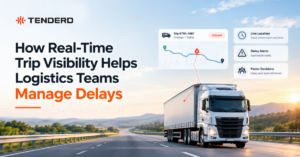
Live answers instead of phone calls. A dispatcher can see the current status and location of every in-progress trip on a map, rather than calling a driver to ask.
Delays and excessive rest caught automatically. Instead of finding out a delivery is late when a customer complains, the system flags it the moment it exceeds a defined threshold.
Less manual dispatch work. Reusable trip templates and automatic trip creation on geofence match mean routine trips do not need to be built from scratch every time.
A defensible operational record. Waybill numbers, load details, distance, duration, and driving-behavior events are captured per trip and exportable for billing, customer reporting, or audits.
Behavior tied to context. Violation events are plotted on the actual route, so a delay or incident can be traced to a specific point in the journey rather than treated as a disconnected statistic.
One picture for every stakeholder. Dispatch and operations teams get real-time exception handling, transportation managers get completed-trip performance data, customer service teams get an accurate answer to “where is my shipment,” and finance teams get the documentation they need for reconciliation.
Logistics Fleet Management in the UAE and GCC
Fleet operations in the UAE and wider GCC carry a specific set of pressures. Job sites are often spread across large industrial zones, ports, or construction developments. Fleets are frequently mixed, combining owned vehicles with equipment supplied by subcontractors. And a meaningful share of assets are rented internally across projects rather than dedicated to a single site.
That combination makes visibility harder to achieve and more valuable once it exists. At AD Ports, deploying real-time tracking, maintenance, and reporting across equipment led to a 30 percent improvement in equipment utilization and a 24 percent decrease in idling time, alongside roughly 1,040 man-hours saved annually on manual data collection and a meaningful reduction in fuel consumption and emissions. On a construction program with ALEC, better visibility and more proactive management of equipment produced a 25 percent improvement in equipment utilization and a 34 percent reduction in equipment downtime, along with clearer shared visibility that helped keep subcontractor coordination on schedule without needing to bring in additional machinery.
The common thread in both cases is not a single feature. It is the shift from fragmented, delayed reporting to a live, shared source of truth that every stakeholder, from equipment operators to strategic leadership, works from.
Challenges and Limitations
Improving fleet efficiency and visibility is not purely a software problem, and it is worth being honest about where the friction shows up.
Adoption is the real bottleneck, not the technology. Rolling out a new tracking or dispatch workflow to operators who are used to radio calls and paper logs takes deliberate change management. The lesson from large-scale deployments like AD Ports is consistent: phased rollouts, peer-led training, and role-specific onboarding matter as much as the platform itself.
Data is only as good as its source. Trip and location data depend on consistent sensor coverage and correctly configured geofences. A poorly drawn geofence or an unreliable GPS unit on one vehicle can undermine confidence in the whole system for the team relying on it.
Not every fleet needs the same depth of configuration. A logistics operation running a handful of well-defined routes has different needs than one coordinating dozens of ad hoc, multi-stop jobs across subcontracted equipment. Thresholds for delay and rest alerts should be set deliberately for the operation, not left at a generic default.
Best Practices for Implementation
Start with your highest-volume routes. Build Trip Configuration templates for the trips that happen most often first, so automatic trip creation and delay detection start delivering value immediately rather than waiting for full rollout.
Set delay and rest thresholds based on real operating conditions, not guesswork. A threshold copied from another fleet or region will either miss real problems or generate so many alerts that dispatchers start ignoring them.
Use completed-trip reports as your source of truth for billing and disputes. Waybill numbers, load data, and per-leg metrics captured automatically remove the back-and-forth that comes from relying on driver-reported information after the fact.
Connect trip data to driving behavior, not just location. A delay is more useful to a fleet manager when it is paired with the driving-behavior context, such as harsh braking or excessive idling, that explains why it happened.
Treat the underlying asset and geofence layer as infrastructure. Trip automation depends on accurately drawn geofences and a clean asset record. Getting that foundation right, through a module like Track, pays off across every downstream workflow, not just logistics.
Invest in adoption alongside the platform. Phased pilots, operator training, and clear ownership of the rollout make the difference between a system that gets used and one that gets worked around.
Manual Dispatch vs. Connected Logistics Fleet Management
| Area | Manual, phone-based dispatch | Connected logistics fleet management |
| Trip status | Requires a call to the driver | Live on a map, updated automatically |
| Delay detection | Found out when the customer complains | Flagged automatically against a defined threshold |
| Trip creation | Opened manually for every job | Can be created automatically on geofence match |
| Driving behavior context | Rarely connected to a specific delay | Plotted directly on the trip’s route |
| Record for billing or disputes | Scattered across calls, notes, and memory | A structured, exportable report per trip |
The Bottom Line
Improving logistics fleet efficiency rarely comes down to buying more vehicles or hiring more dispatchers. It comes down to closing the gap between what is actually happening on the road and what the operations team can see. Fleets that connect live location tracking, automated trip management, and driving-behavior context into one system spend less time chasing status updates and more time managing the exceptions that actually need attention.
If your team is still relying on phone calls and spreadsheets to answer “where is this shipment,” it may be worth seeing what a connected view of your trips looks like in practice. Book a demo of TENDERD Logistics to see live trip tracking, automated delay detection, and completed-trip reporting working on your own fleet’s data.
Frequently Asked Questions
What is the difference between fleet management and logistics fleet management?
Fleet management focuses on the vehicles and equipment themselves, such as their location, condition, and utilization. Logistics fleet management builds on that foundation to manage the trips those vehicles are performing, including stops, delays, delivery timing, and the operational record of each journey.
How does real-time visibility actually reduce costs?
It removes the time and guesswork spent chasing status updates, catches delays early enough to manage customer expectations, and replaces disputed, manually reported trip details with a documented record that reduces billing and compliance friction.
an trips be tracked automatically without a dispatcher creating them manually?
Yes, when trips are built from a reusable configuration with geofence-based start and completion triggers, a new trip can be generated automatically the moment a vehicle's movement matches the defined pattern, without manual entry.
What should a logistics fleet report actually include?
At a minimum, a useful completed-trip report includes the trip and waybill identifiers, load details, distance and duration per leg, any delay or rest flags, and any driving-behavior violations tied to specific points on the route.
Does improving logistics visibility also improve safety?
It can, since plotting driving-behavior events like harsh acceleration or overspeeding directly on a trip's route connects incidents to a specific location and moment, giving safety and operations teams the context needed to address root causes rather than just react to reports.