 TL;DR: One-Minute Brief
 TL;DR: One-Minute Brief
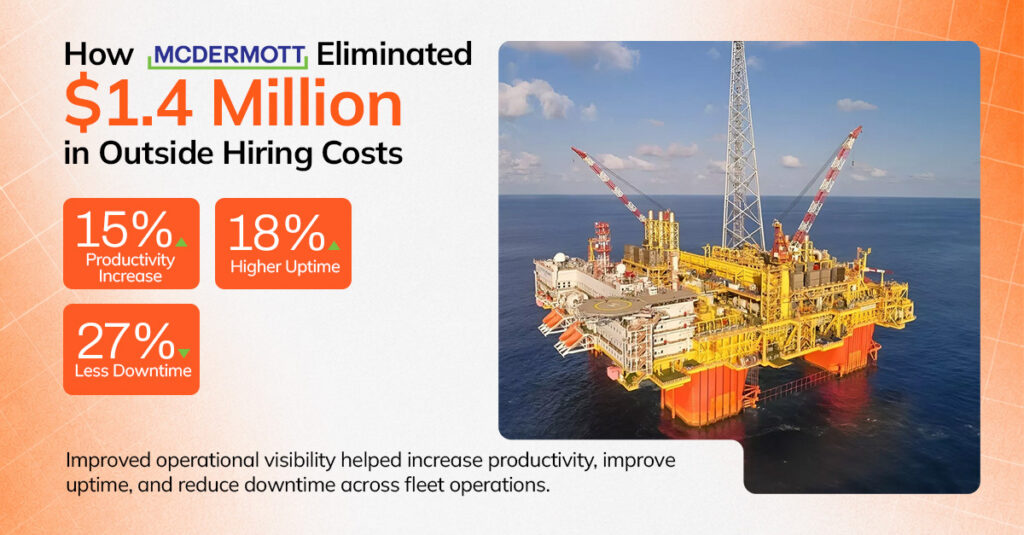
When a large yard and marine operation has no live way to see what its equipment is actually doing, the default fix is more people, extra supervisors and inspectors brought on to cover the visibility gap manually. This is the story of how McDermott closed that gap with real-time, AI-driven equipment monitoring instead, eliminating 1.4 million dollars in outside hiring costs while cutting downtime by 27 percent and lifting productivity and safety at the same time.
The Problem: Paying People to Compensate for a Visibility Gap
Running a large-scale yard and marine operation means keeping track of a wide mix of equipment across a sprawling site, in McDermott’s case, more than a thousand yard and barge assets moving through the same operation. Without a live, automated way to see what every piece of equipment was actually doing at any given moment, the practical answer to that visibility problem was headcount: bringing on additional outside supervisors and inspectors whose job was essentially to be extra eyes on the yard, manually checking on equipment status, utilization, and safety conditions that a system should have been able to report automatically.
That approach worked, in the sense that it got the visibility McDermott needed, but it was an expensive way to solve what was fundamentally a data problem with a headcount solution. Every additional supervisor or inspector brought on to cover the gap was a recurring cost that would keep accumulating for as long as the underlying visibility problem remained unsolved, rather than a one-time fix.
The Approach: Real-Time, AI-Driven Equipment Monitoring
McDermott’s move was to replace that manual oversight layer with a system built to provide the same visibility automatically. AI-driven monitoring across the equipment fleet gave the operation a live, continuous view of what machines were doing, working, idling, or flagged for attention, without needing a person physically watching each one. That same real-time visibility extended into safety monitoring, giving the team automated awareness of conditions that previously required manual inspection to catch.
The shift wasn’t about adding another layer on top of the existing manual process. It was about removing the need for that manual layer entirely, letting the system provide the continuous coverage that used to require additional outside hires to deliver.
The Result: $1.4M in Costs Eliminated, 27% Less Downtime
The most direct result was financial: real-time visibility eliminated the need for the outside hiring that had been covering the gap, removing 1.4 million dollars in associated costs. That number reflects a recurring cost that stopped needing to recur, not a one-time saving, since the supervisory and inspection headcount that visibility gap used to require was no longer necessary once the system could provide the same coverage automatically.
Alongside that, AI-driven equipment monitoring boosted productivity and safety across the operation while cutting downtime by 27 percent. Reduced downtime in particular reflects what continuous visibility makes possible that manual, periodic inspection cannot: catching equipment issues and unsafe conditions closer to the moment they start, rather than at whatever interval a human inspection cycle happened to allow.
What This Case Shows About the Cost of Manual Visibility
McDermott’s experience is a clear example of a pattern that shows up across large, equipment-heavy operations: when there’s no automated way to see what’s happening across a fleet, the gap gets filled with people, and that solution scales in cost exactly as fast as the operation grows. A visibility problem solved with headcount keeps costing more as the fleet expands, while a visibility problem solved with real-time monitoring scales without that same growing cost, and, in McDermott’s case, delivered a meaningful downtime reduction on top of the direct cost savings.
How Tenderd Helped McDermott Get There
Tenderd’s real-time, AI-driven equipment monitoring gave McDermott continuous visibility across a yard and marine operation of more than a thousand assets, without relying on additional outside supervisors and inspectors to cover the gap manually. That shift eliminated 1.4 million dollars in outside hiring costs while cutting downtime by 27 percent and improving productivity and safety across the operation.
The Bottom Line
When a fleet has no automated way to see what’s happening, the visibility gap gets filled with people, and that fix gets more expensive as the operation grows. McDermott’s results show what happens when that gap gets closed with real-time monitoring instead: a large, recurring cost eliminated, and a meaningful drop in downtime as a direct result of catching issues earlier.
Want to see what replacing manual oversight with real-time visibility could look like for your own operation? Get in touch with the Tenderd team for a walkthrough: Book a Demo
Frequently Asked Questions
Why was McDermott spending on outside hiring in the first place?
Without a live, automated way to monitor equipment status, utilization, and safety conditions across a large yard and marine operation, additional outside supervisors and inspectors were brought on to cover that visibility gap manually.
How did real-time monitoring eliminate that hiring cost specifically?
Once AI-driven monitoring could automatically provide the equipment and safety visibility that outside hires had been manually covering, the recurring need for that additional headcount went away, along with its associated cost.
What caused the 27 percent reduction in downtime?
Continuous, real-time monitoring catches equipment issues closer to the moment they start, rather than only at whatever interval a periodic manual inspection allowed, which is what drives a meaningful reduction in downtime.
Does this kind of visibility gap only affect large operations?
The pattern shows up wherever manual oversight is being used to compensate for a lack of automated visibility, but it becomes more expensive as an operation scales, since headcount-based coverage keeps costing more as the fleet grows.
Is cost savings the only benefit of this kind of monitoring?
No. In McDermott's case, the same real-time monitoring that eliminated outside hiring costs also improved productivity and safety, showing that the visibility gap being solved had implications well beyond headcount spend alone.