Summary
 Summary
Equipment allocation tracking is the practice of knowing, at any moment, which asset is assigned to which job, where it physically is, and whether it is actually available for the next request. Fleet and equipment-heavy operations lose this visibility when booking, dispatch, and location data live in separate spreadsheets and systems. Connecting the request-to-assignment process with real-time location and utilization data closes that gap, so equipment managers can allocate with confidence instead of guesswork.
Key Takeaways
- Allocation tracking fails most often not because equipment goes missing, but because the booking record and the machine’s actual location and status are disconnected.
- A request-to-assignment workflow that checks real booking and maintenance schedules before confirming an assignment prevents double-booking and last-minute substitutions.
- Linking every booked unit to its live location, permit status, and dispatch history turns allocation from a paperwork exercise into an operational control.
- Equipment managers who can see utilization alongside availability make faster, better-informed decisions on whether to allocate, rent, or hold.
Introduction
Ask most equipment managers how they know a specific excavator, generator, or forklift is where it’s supposed to be, and the honest answer is usually a mix of a spreadsheet, a WhatsApp message, and a phone call to the site. That gap between what the paperwork says and what is actually happening on site is where allocation problems start: a unit gets double-booked, a certificate expires mid-deployment, or a machine sits idle at one site while another site raises an urgent request for the same equipment type.
This article looks at what equipment allocation tracking actually involves, why it breaks down in most fleet operations, and how connecting the booking process to real-time asset data changes the picture for fleet managers, equipment managers, and operations leaders running mixed fleets across multiple sites.
What is Equipment Allocation Tracking?
Equipment allocation tracking is the process of managing and monitoring which physical asset is assigned to which work request, for what period, and confirming that assignment against the asset’s real availability, location, and condition.
It covers the full lifecycle of a request: a site raises a need for equipment, that need is approved, a specific unit is matched and assigned against it, the unit is dispatched, and it is eventually returned or reassigned. Done well, allocation tracking also carries the operational detail that determines whether an assignment is safe and workable in practice, such as whether the unit’s certifications are valid for the full work period and whether it has other bookings that overlap.
How Does Equipment Allocation Tracking Work?
In most fleets, the process starts with a request: a site team specifies the equipment type and quantity needed, the work period, and the site the equipment should come from. That request typically moves through an approval chain before anyone touches a physical asset, often involving a site manager who confirms the need is legitimate and prioritized correctly.
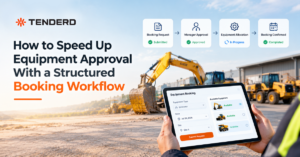
The harder part comes next: matching that approved request to an actual unit. This is where allocation tracking earns its value. Before a specific machine is assigned, someone needs to check whether it is genuinely free for the requested dates, whether it is due for maintenance during that window, and whether its certificates will still be valid across the full work period. Tenderd’s Bookings module structures this as a distinct assignment step, where the assigner can see each candidate unit’s booking schedule and maintenance schedule side by side before confirming, and the system flags whether a request is completely matching, every requested unit has a suitable match, or only partially matching, meaning a substitute or shortfall needs to be resolved before work starts.
Once a unit is confirmed, the allocation record does not stop there. The same request tracks dispatch and return for each individual assigned unit, including whether it arrived early, on time, or late against plan. This is where allocation tracking connects to the Track module: rather than maintaining a separate log of where equipment physically is, an allocation record links directly into the machine’s live location, movement history, and geofence activity, so a site manager or equipment manager isn’t reconciling two different sources of truth to answer a simple question: is this unit actually where the booking says it should be?
Why is Allocation Tracking Important?
When allocation and location data are disconnected, the consequences show up in a few predictable ways. Equipment gets double-booked because the person approving a new request cannot see that a unit is already committed elsewhere. Sites hold onto machines longer than needed because there is no visibility into whether another site urgently needs that same asset type. Certified equipment gets deployed with an expired permit because certificate expiry was tracked separately from the booking decision. And when someone finally does need to locate a specific unit, whether for maintenance, a safety review, or simply to confirm it made it to site, the answer requires a phone call rather than a screen.
These are not minor inconveniences. On a large mixed fleet, unresolved allocation gaps compound: idle equipment at one site represents unnecessary rental spend or delayed work at another, and a missed permit expiry becomes a compliance exposure. Aramco Mobility’s own experience managing a large, dispersed asset pool across Saudi Arabia illustrates the pattern: strong operational objectives were undermined by a lack of real-time visibility into equipment allocation and site operations, with heavy reliance on delayed manual reporting standing in the way of establishing a clear baseline and tracking progress.
Key Benefits of Connected Allocation Tracking
Fewer double-bookings and last-minute substitutions. Checking a unit’s existing booking and maintenance schedule before confirming an assignment catches conflicts before they become a problem on site, not after a truck has already been dispatched.
Certification stays ahead of deployment. Permit expiry checked per assigned unit, against the actual requested work period, means equipment managers know at the point of assignment whether a certificate will lapse mid-job, not after an inspection flags it.
One record instead of two. Because dispatch tracking, utilization figures, and equipment status in a booking record draw on the same underlying machine data captured in Track, teams are not reconciling a booking spreadsheet against a separate tracking system to find out what actually happened.
Better decisions on what to allocate versus rent. Visibility into which owned units are idle, in use, or coming available shifts the allocation decision from “what do we have on paper” to “what is actually free, where, and for how long,” which is exactly the kind of oversight that lets operations leaders reduce unnecessary rental spend across a mixed fleet.
A full timeline for every request. A running record of who raised a request, who approved it, who assigned the equipment, and who signed off gives equipment managers an audit trail without anyone having to reconstruct it manually after the fact.
Allocation Tracking in Construction, Mining, and Heavy Industry
Construction, mining, and energy operations tend to run mixed fleets across multiple, often remote, sites, with equipment moving between projects as work phases shift. This is exactly the environment where allocation tracking under strain shows up fastest: a site manager needing a compactor for two weeks has no easy way to know whether a similar unit is finishing up at a nearby project, so a new unit gets rented or requested from a central pool that already had one available.
It’s also the environment where the operational stakes of a bad allocation are highest. A generator or crane arriving late because of an unflagged scheduling conflict can hold up an entire crew. A piece of lifting equipment deployed with an expired certificate is a safety and compliance issue, not just a paperwork gap. For fleet and equipment managers running large asset pools across dispersed sites, connecting the request-to-assignment process to real location and maintenance data is less a convenience and more a baseline requirement for keeping projects on schedule and within budget.
Challenges and Limitations
Allocation tracking is only as good as the data feeding it. If a booking is confirmed but the physical handover or return is never logged, the system will show a unit as assigned long after it has actually come back, undermining the very visibility the process is meant to provide. Getting site teams to log requests and returns consistently, rather than defaulting to informal channels, is as much a change-management challenge as a technology one.
It’s also worth being clear-eyed about what allocation tracking can and cannot do on its own. Matching recommendations and utilization insights that surface during the assignment step can speed up the decision, but they still depend on an assigner confirming the match is right for the job, not simply accepting a suggestion. And allocation visibility solves the problem of knowing what’s available and where; it does not by itself fix an underlying shortage of equipment or an unrealistic project schedule.
Best Practices for Implementing Allocation Tracking
Start by standardizing the request itself. Every request should capture equipment type, quantity, work period, required certificates, and the site the equipment is coming from, so approvers and assigners are working from consistent, complete information rather than filling gaps after the fact.
Make the assignment step a real check, not a formality. Before confirming a unit against a request, verify its existing booking schedule, upcoming maintenance, and certificate expiry against the requested work period. This single step prevents the majority of allocation conflicts before equipment ever leaves the yard.
Keep dispatch and return logging tied to the same record as the request. When arrival, departure, and return status are tracked against the original booking rather than in a separate log, there is one source of truth for whether a unit is genuinely available for the next request.
Give equipment managers a fleet-wide view, not just a site-level one. Visibility scoped only to a single site’s requests makes it easy to miss that a similar unit is sitting idle two sites over. A view oriented around the physical asset, its utilization, and its current status across every request is what turns allocation from reactive to proactive.
Review permit and certification status as part of the allocation decision, not as a separate compliance task. Checking expiry at the point of assignment, against the actual requested period, catches problems while there is still time to act on them.
The Bottom Line
Allocation tracking breaks down when the booking record and the physical reality of a fleet live in separate systems. The fix isn’t a stricter spreadsheet; it’s connecting the request-to-assignment workflow directly to real-time location, utilization, and maintenance data, so every allocation decision is made against what is actually happening on the ground. For fleet and equipment managers running mixed assets across multiple sites, that connection is what turns allocation from a recurring source of delays and compliance risk into a routine operational control.
If your team is still reconciling booking spreadsheets against a separate tracking system, it’s worth seeing what a connected view of requests, assignments, and live asset location looks like in practice.
Frequently Asked Questions
What is the difference between equipment tracking and equipment allocation tracking?
Equipment tracking generally refers to knowing a machine's live location and movement history. Allocation tracking builds on that by connecting location and availability to the booking and assignment process, so a fleet knows not just where a unit is, but whether it is committed, available, or overdue for maintenance against upcoming requests.
How does allocation tracking reduce equipment downtime?
By checking a unit's maintenance schedule at the point of assignment, allocation tracking helps avoid booking equipment into a work period when it is due for service, and by surfacing idle units across a fleet, it reduces the time equipment sits unused between assignments.
Can allocation tracking prevent double-booking?
Yes, when the assignment step checks a candidate unit's existing bookings before confirmation. Systems that treat booking and dispatch as separate, disconnected records are far more prone to double-booking than those that check real-time availability at the point of assignment.
Is allocation tracking only relevant for large fleets?
No. Smaller fleets feel double-bookings and certificate gaps just as acutely, often with less slack to absorb the disruption. The value scales with how many sites and requests are competing for the same pool of equipment, not simply fleet size.