 Summary
 Summary
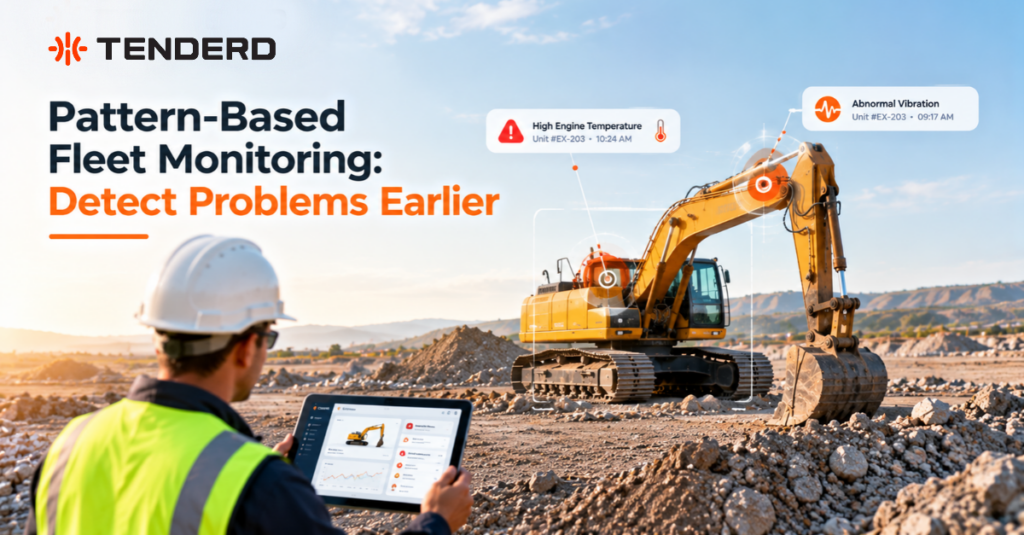
Monitor for repeated conditions, not single events. One harsh braking alert or one idle hour is usually noise. The same violation on consecutive trips, or a machine below its utilization target several days running, is a real problem forming. Pattern-based fleet monitoring records every event, waits until a condition repeats, then puts it in front of the person who can act, often weeks before it would appear in a monthly report.
Key Takeaways
- A single event is a data point; a repeated condition is a problem.
- More alerts do not mean earlier detection. They create volume that teams stop reading.
- Pattern-based does not mean slower. The alternative is discovery at month-end or after the incident.
Why Fleet Problems Are Found Late
Most fleet problems look harmless the first time. An excavator idles through one lunch break. An operator brakes hard once on a site road. Nobody acts, and nobody should.
The cost comes from repetition. The excavator idles every lunch break for a month. The operator brakes hard on the same road for two weeks. By the time anyone notices, the pattern has already burned fuel, added wear or created safety exposure.
Threshold alerts do not fix this. In a TENDERD pilot across 35 assets, teams faced 59 safety alerts per truck, per week, at baseline. At that volume, the alert that signals a real pattern looks identical to the forty that do not.
Threshold Alerts vs Pattern-Based Monitoring
| Comparison Area | Threshold alerting | Pattern-based monitoring |
|---|---|---|
| Trigger | One reading crosses a limit | A condition repeats consistently |
| Volume | High | Low |
| Who filters noise | The person receiving it | The system |
| Best for | Critical one-off events (crash, fuel theft) | Problems that build over time |
Both have a place. A crash needs an immediate alert. Most operational problems, though, only become problems through repetition.
Four Patterns Worth Catching Early
1. Repeat unsafe behavior. The same violation by the same operator on consecutive trips needs a coaching conversation this week. Patterns also expose causes: harsh braking across several drivers on one route usually points to the road, not the drivers.
2. Sustained idling. One idle stretch is normal. A machine that idles through every truck shortage and lunch break is burning fuel with no output. On GCC sites, summer makes this worse, as engines are left running to keep cabs cool.
3. Equipment underused for days. A quiet day means nothing. A machine below target for several consecutive days should be reassigned before another work front rents the same equipment type.
4. A failure trend ahead of the next service. Hourmeter and calendar schedules only check a machine when the interval comes up. If a component is degrading faster, the failure can land first. Catching the trend lets the machine be pulled into an earlier maintenance window.
Proof in Practice: AD Ports
AD Ports runs round-the-clock operations across multiple terminals and faced underused and overloaded equipment, little real-time efficiency data and heavy idling. TENDERD now monitors 172 machines there, with engine on time and idling time tracked separately for every asset.
Seeing which machines were consistently overloaded, underused or idling allowed AD Ports to redistribute the fleet. Results:
- 30% improvement in equipment utilization
- 24% decrease in idling time
- 763,000 liters per year less fuel
- 2,000 tonnes of CO2 reduced annually
How TENDERD Detects Patterns
TENDERD’s AI runs five agents in the background. None acts on a first occurrence. Each waits for a pattern, then calls the person responsible:
| Agent | Pattern | Who it calls |
|---|---|---|
| Driver Safety | Consecutive violations of the same type by one operator | Supervisor first; operator only after approval |
| Fuel Monitoring | Idling sustained well beyond normal | Fleet manager |
| Equipment Reassignment | Utilization below threshold for consecutive days | Operations manager |
| Predictive Maintenance | A condition trend that will fail before the scheduled service | Maintenance manager |
| Welding Productivity | Top performer by arc-on time at shift end | The welder, with a recognition call |
The call is a real two-way conversation in English, recorded and transcribed. If it goes unanswered and the condition persists, the agent calls again.
The agents read from the same records behind Safety (operator scores and violation history), Fuel (working vs idling fuel), Productivity (utilization vs idle hours) and Maintenance (service schedules and history), so an escalation always matches what the dashboard shows.
Best Practices
- Keep real-time alerts for truly critical events only. Let everything else build into patterns.
- Define the pattern per problem. Consecutive trips for behavior, consecutive days for utilization, trends for condition.
- Route each pattern to its decision owner. A fuel pattern sent to the wrong person produces no action.
- Check underuse before approving new equipment. Reassignment is usually cheaper than renting.
The Bottom Line
Most fleets do not need more alerts. They need to know which events are the start of something. Pattern-based fleet monitoring filters out the noise and delivers confirmed problems to the person who can fix them, while they are still cheap to fix.
Book a demo of TENDERD to see pattern-based escalation on your own fleet data.
Frequently Asked Questions
What is pattern-based fleet monitoring?
It is an approach that acts when a condition repeats consistently, such as the same violation on consecutive trips or a machine underused for several days in a row. Single events are recorded but do not trigger escalation on their own.
Does waiting for a pattern mean problems are detected later?
No. A pattern is confirmed after a few repetitions, which is usually weeks earlier than a monthly report or incident review. Critical one-off events, such as a crash, should still trigger an immediate alert.
Why do fleet teams ignore alerts?
Because most alerts describe isolated events that need no action. At high volume, the person reading them has to separate signal from noise, and real problems get lost.
Does TENDERD's AI take action on its own?
No. The agents decide a person should be told and call that person. They do not reassign machines, schedule services or change records, and a supervisor must approve before any operator is contacted about safety.