 Summary
 Summary
Double-booking happens when two sites or crews are promised the same piece of equipment for overlapping work periods, usually because availability lives in separate spreadsheets, phone calls, or site-level logs instead of one shared record. Preventing it comes down to giving every site the same real-time view of what equipment exists, where it is, and what it’s already committed to, so a request can only be approved against equipment that is actually free.
Key Takeaways
- Double-booking is a visibility problem, not a discipline problem. It happens when one site can’t see what another site has already committed.
- It gets worse as fleets grow, because construction equipment moves between job sites on short notice instead of returning to a base every night.
- Subcontractor-supplied equipment adds a layer most booking tools don’t account for, since that availability sits partly outside the fleet owner’s own system.
- The fix is centralizing requests and asset status in one place, not adding another manual coordination step on top of the existing ones.
Introduction
A double-booked excavator is a specific kind of expensive mistake. Two site teams each believe they have the machine for the same week. One of them finds out only when it doesn’t show up. What follows is a scramble: a call to the rental yard, a schedule reshuffle, an uncomfortable conversation with a subcontractor who was told equipment would be on site. None of this happens because anyone was careless. It happens because the information that would have prevented it, that the machine was already committed, existed somewhere the second site couldn’t see.
This gets more common, not less, as a fleet grows across multiple active projects. A contractor running one or two sites can usually keep equipment commitments straight with a shared calendar and a few phone calls. Once a fleet is moving equipment across three, four, or a dozen concurrent sites, with some of that equipment owned and some supplied by subcontractors, informal coordination stops working. This article looks at why double-booking happens, what it actually costs a project when it does, and what a fleet needs in place to stop it.
What is Equipment Double-Booking?
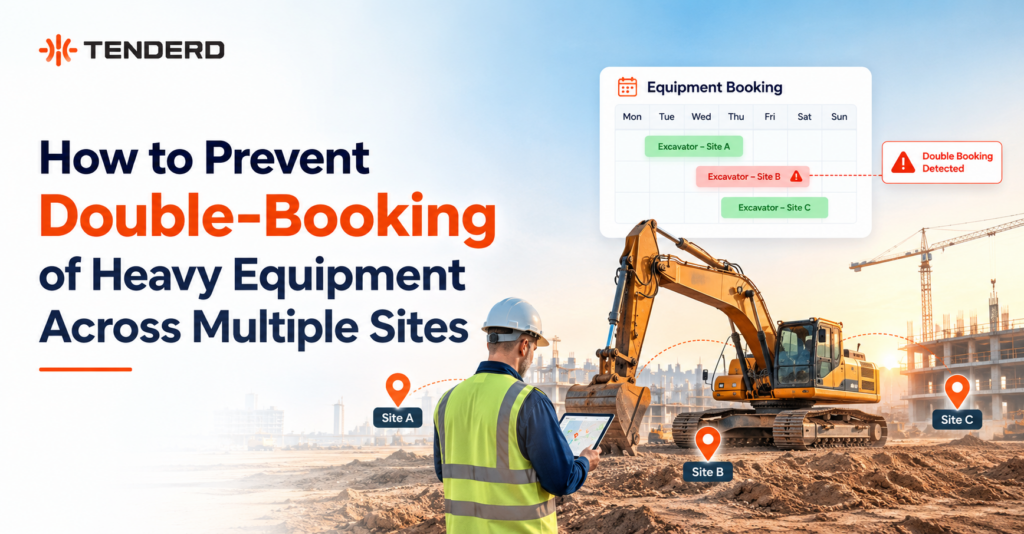
Equipment double-booking is when two separate requests get approved against the same physical unit for overlapping work periods. It’s a coordination failure, not a supply problem. The fleet may have plenty of excavators overall; the issue is that two people believed the same specific excavator was theirs for the same week.
This is worth separating from two problems it often gets confused with. Equipment scarcity is when a fleet genuinely doesn’t have enough of a given machine type to meet demand. Poor utilization is when equipment sits idle at one site while another site pays to hire the same machine type externally. Double-booking is different from both: it’s what happens when the information about what’s already committed doesn’t reach the people making the next commitment.
Why Double-Booking Happens on Multi-Site Projects
Three things compound to make this a persistent problem rather than an occasional slip.
The first is fragmented tracking. When each site keeps its own record of what equipment it has requested, whether on paper, in a spreadsheet, or in someone’s memory, there’s no single place where a fleet or equipment manager can see every commitment at once. A request that looks perfectly reasonable from one site’s point of view can directly conflict with a request another site made a week earlier.
The second is equipment mobility. Construction equipment doesn’t behave like a delivery fleet that returns to a depot every night. An excavator might be on a residential site this week and move to a commercial project eighty kilometers away the next, sometimes with only a few days’ notice as project schedules shift for weather, sequencing, or client changes. That constant movement means the current location and status of a unit is a moving target, and any system that only updates status periodically, rather than continuously, will eventually approve a booking against equipment that’s already gone somewhere else.
The third, and the one that gets the least attention in most guidance on this topic, is subcontractor-supplied equipment. On many multi-site projects, a meaningful share of the fleet in use isn’t owned by the general contractor at all. It’s brought in by subcontractors, moved between projects as their own schedules require, and only partially visible to the fleet owner’s own tracking. A booking system built only around owned assets will always have a blind spot here, because the equipment causing the conflict may not be in that system at all.
The Real Cost of Double-Booking
The cost of a double-booking rarely shows up as a single line item. It shows up as a sequence of smaller costs that compound. The site that loses the equipment has to either wait, which pushes back every task sequenced after it, or source a replacement on short notice, usually at a worse rate than a planned rental would have cost. The crew scheduled around that equipment sits partially idle in the meantime. If a subcontractor was told the equipment would be available and it wasn’t, that’s a relationship cost as much as a financial one, and it tends to surface again at the next scheduling conversation in the form of padded requests and reduced trust.
None of this needs an inflated number attached to it to be worth solving. A single missed work period on a critical piece of equipment, multiplied across a fleet running several concurrent sites, adds up to a meaningful amount of avoidable disruption over the course of a project.
Why This Gets Harder With Subcontractor-Supplied Equipment
This is where most generic booking guidance stops short. It’s relatively straightforward to prevent double-booking within a fleet you fully own and fully track. It’s a different problem when a large share of the equipment in active use is supplied by subcontractors and moved between projects on their own scheduling logic.
Aramco Mobility’s equipment operation illustrates the scale this reaches in practice. The team manages a mixed fleet of 15,000 assets, including vehicles, stationary equipment, heavy machinery, and lifting equipment, deployed across Saudi Arabia to support Aramco’s operations. Alongside its owned fleet, a large share of that equipment is supplied by subcontractors, with assets frequently rented internally across different projects. At that scale, informal coordination isn’t a viable option. The team needed a way to see equipment allocation and site operations in real time rather than relying on delayed manual reporting, across both owned and subcontractor-supplied equipment, to avoid exactly the kind of conflict that happens when one part of the operation doesn’t know what another part has already committed.
What Actually Prevents Double-Booking
The consistent thread across every cause above is visibility: no single fixed rule or process change solves this if the underlying information about equipment status still lives in separate places. What prevents double-booking is a centralized system where every equipment request and every asset’s current status live in the same place, visible to every site, not just the one that made the request.
In practice, that means every site raising a request for equipment can see, before submitting it, what’s genuinely available rather than what they assume is available. It means an asset’s status, available, currently assigned, in maintenance, is a single source of truth rather than something each site tracks separately. And it means that status is tied to the same underlying record as the equipment’s maintenance schedule and permit or certification status, so a unit isn’t just free on paper but actually usable for the work it’s being requested for.
TENDERD’s Equipment Allocation module works this way: equipment requests are centralized rather than tracked per site, and every piece of bookable equipment carries a live status, including utilization, upcoming maintenance, and permit expiry, alongside a clear available status when it isn’t currently tied to any request. That status connects to the same asset data tracked in Track, so the equipment record a site sees reflects where a unit actually is and what condition it’s in, not a static entry that goes stale between updates.
Aramco Mobility: Managing Allocation Across a 15,000-Asset Mixed Fleet
Aramco Mobility oversees a large and dispersed asset pool supporting Aramco’s energy operations across Saudi Arabia, a mixed fleet of roughly 15,000 assets spanning vehicles, stationary equipment, heavy machinery, and lifting equipment. In addition to its owned fleet, a significant share of equipment is supplied by subcontractors, with assets frequently rented internally across different projects to meet shifting demand.
Despite having clearly defined objectives, the team lacked the real-time visibility needed to establish a reliable baseline, enforce consistent policy, and track progress across such a large and mobile pool of equipment. Much of the operation relied on delayed manual reporting, which meant equipment allocation and site-level operations weren’t visible in real time, a gap that becomes a direct double-booking risk once equipment is moving across many concurrent projects and multiple supply sources. Aramco partnered with TENDERD to pilot a unified platform across 35 diverse assets, including generators, forklifts, welding machines, compressors, AC machines, and cargo trucks, as an initial step toward centralizing that visibility across the broader operation.
Best Practices for Multi-Site Equipment Allocation
- Centralize the request process. Every site should raise equipment requests through the same system, not through separate site-level habits, so no request is made blind to what’s already committed elsewhere.
- Make asset status visible fleet-wide, not just to the requesting site. A site shouldn’t have to call around to find out if a unit is free; that status should be visible the moment they open a request.
- Track subcontractor-supplied equipment in the same system as owned equipment. If a meaningful share of the fleet in use sits outside the tracking system, the system can’t actually prevent conflicts involving that equipment.
- Review allocation proactively rather than reactively. Checking what’s committed for the coming weeks, rather than finding out when a truck doesn’t show up, catches conflicts while there’s still time to resolve them without disrupting a schedule.
Conclusion
Double-booking isn’t a discipline problem that better scheduling habits fix on their own. It’s what happens when the information needed to make a safe commitment, what’s already promised, where a unit actually is, whether it’s supplied by a subcontractor or owned outright, doesn’t reach the person making the next request. Fleets that solve it do so by putting that information in one place every site can see, not by asking teams to coordinate harder. For a fleet managing equipment across multiple sites and multiple supply sources, that centralized visibility is the difference between catching a conflict before it happens and finding out about it when a truck doesn’t show up.
If equipment across your sites is still being tracked in separate spreadsheets or site-level logs, it’s worth seeing what a single, live view of every request and every asset’s status looks like. See how TENDERD’s Equipment Allocation module centralizes equipment allocation across multiple sites.
Frequently Asked Questions
What causes equipment double-booking on multi-site construction projects?
It happens when equipment availability is tracked separately by each site rather than in one shared system, so a site can approve a request without visibility into commitments another site has already made.
How does subcontractor-supplied equipment complicate booking?
Subcontractor equipment often moves between projects on the subcontractor's own scheduling logic and isn't fully visible in the fleet owner's own tracking, creating a blind spot that owned-equipment-only booking systems don't account for.
What should equipment booking software actually prevent?
It should give every site the same live view of equipment status, including whether a unit is available, already assigned, or in maintenance, so a request can only be approved against equipment that's genuinely free for that work period.
Is double-booking mainly a problem for large fleets?
It becomes a persistent risk once a fleet is running equipment across three or more concurrent sites, since informal coordination that works for one or two sites stops scaling from there.
How is this different from an equipment utilization problem?
Utilization is about equipment sitting idle when it could be working. Double-booking is a coordination failure, two commitments made against the same unit, and can happen even in a fleet with excellent overall utilization.