 Summary
 Summary
A safety report lands on a manager’s desk explaining exactly what went wrong last month, complete with charts and a breakdown by site, and none of that detail does anything to stop next month’s incident, because the report only exists after the fact. This blog covers why piling on more safety reports doesn’t actually reduce risk, and how monitoring safety events in real time, so problems are visible before they become incidents, is a fundamentally different thing than reporting on them afterward.
The Report Explains What Already Happened
A monthly safety report arrives, thorough and well-organized: total violations, a breakdown by site, a trend line showing whether things are getting better or worse. It answers, in detail, exactly what happened last month. What it doesn’t do, no matter how well it’s built, is prevent anything, because by the time the report exists, every incident and near miss in it has already occurred. The report is a historical document, and no amount of additional detail in a historical document changes what happens on the road or the yard floor tomorrow.
This is the trap of treating more reporting as the answer to a safety problem. A team that already reviews safety data monthly and decides the fix is a more detailed report, a better breakdown, an additional chart, is optimizing the wrong thing. The problem was never a lack of information about what already went wrong. It’s a lack of visibility into what’s happening right now, while there’s still time to do something about it.
Why Doesn’t More Reporting Actually Reduce Risk?
A report, no matter how granular, is fundamentally reactive. It aggregates events that have already happened into a format a person can review, which is useful for spotting long-term trends and holding coaching conversations, but structurally incapable of catching the specific unsafe event happening on a specific vehicle right now. Adding more detail to that report, more categories, more filters, a finer breakdown by shift, doesn’t change its timing. It’s still explaining the past, just with more precision.
Meanwhile, the actual moment that mattered, the harsh braking event, the phone glance at highway speed, the machine drifting too close to a restricted zone, passed by unnoticed in real time, because nobody was watching for it as it happened. A more detailed report of that event after the fact doesn’t recover the chance to intervene before it became a data point. That opportunity only exists in the moment, not in whatever summary gets built from it afterward.
How Do Teams Typically Respond to a Safety Problem With More Reporting?
- Add more categories or filters to an existing safety report, hoping additional detail will surface the real issue.
- Increase the frequency of reporting, from monthly to weekly, without changing what triggers a response.
- Review historical trends to identify a pattern, then wait for the next reporting cycle to see if it’s improved.
- Treat a thorough, well-designed report as evidence that the safety program itself is working.
- Discover a specific unsafe pattern only after enough incidents have accumulated to show up clearly in the data.
Each of these responses improves the quality of the historical record without doing anything to catch the next unsafe event while it’s still happening.
What Changes When Safety Events Are Monitored in Real Time?
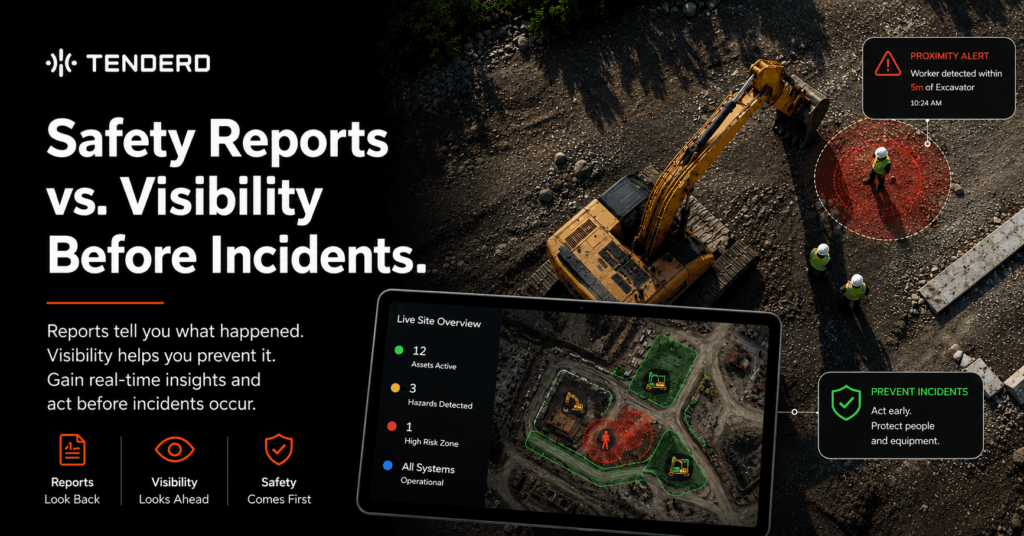
The fix isn’t a better report, it’s a fundamentally different capability: seeing an unsafe event the moment it happens, rather than reading about it afterward. Continuous, automatic monitoring of driver and machine behavior means harsh braking, distraction, a proximity risk, or a zone violation gets detected and surfaced as it occurs, not aggregated into next month’s summary. That shifts the entire nature of what a safety team is doing, from reviewing what happened to being aware of what’s happening, which is the only version of safety oversight that can actually intervene before an incident rather than just documenting it after.
This doesn’t replace reporting entirely, historical trends still matter for coaching and for spotting long-term patterns, but it changes what reporting is for. Instead of being the primary tool for managing safety, reporting becomes a secondary layer that summarizes what real-time visibility already caught and acted on, rather than the only mechanism a team has for knowing anything went wrong at all.
Safety Reporting vs. Real-Time Safety Visibility
| Factor | Safety Reporting | Real-Time Safety Visibility |
| When an event is known | After it’s aggregated into a report | The moment it happens |
| Ability to intervene | None, the event has already occurred | Possible, while the event is unfolding or just after |
| What it’s useful for | Trend analysis, coaching, audits | Catching and acting on unsafe behavior directly |
| Primary role in a safety program | Historical record | Operational awareness |
| Response to more detail added | Better documentation of the past | Not applicable, detail isn’t the goal, timing is |
Common Mistakes That Mistake More Reporting for More Safety
- Adding more categories, charts, or filters to a report, assuming more detail will translate into more prevention.
- Increasing reporting frequency without changing whether anyone can act on an event as it happens.
- Treating a well-designed safety report as proof the safety program itself is effective.
- Waiting for a pattern to become obvious in historical data instead of catching individual events as they occur.
- Relying entirely on reporting for safety oversight, with no real-time layer underneath it.
How Tenderd Helps Deliver Visibility Before Incidents, Not Just Reports After
Tenderd’s Safety module monitors driving behavior, zone compliance, operator attention, proximity risk, and machine health continuously, surfacing an unsafe event the moment it’s detected rather than waiting for it to appear in a scheduled report. A live dashboard shows the fleet’s highest-risk machines, operators, and locations in real time, giving teams the chance to intervene while an issue is developing, with historical reporting available as a secondary layer for trend analysis and coaching, not as the primary way anyone finds out something went wrong.
The Bottom Line
A safety report, however detailed, can only ever explain what already happened. Reducing actual risk requires seeing an unsafe event the moment it occurs, not reading about it in next month’s summary. More reporting improves the historical record. Real-time visibility is what actually gives a team the chance to act before an incident, not just after one.
Want to see what real-time safety visibility looks like compared to your current reporting cycle? Get in touch with the Tenderd team for a walkthrough: Book a Demo
Frequently Asked Questions
Why doesn't adding more detail to a safety report reduce actual risk?
A report is inherently historical, summarizing events that have already happened. No matter how detailed it gets, it can't recover the moment when an intervention could have prevented the event in the first place.
What's the difference between safety reporting and real-time safety visibility?
Reporting aggregates past events into a reviewable summary, useful for trends and coaching. Real-time visibility surfaces an unsafe event the moment it happens, which is the only version that allows for actual intervention.
Does real-time monitoring mean safety reports are no longer needed?
No. Reports still matter for spotting long-term trends and supporting coaching conversations, but they become a secondary layer summarizing what real-time monitoring already caught, rather than the primary way a team learns something went wrong.
How does real-time visibility change what a safety team can actually do?
It shifts the team from reviewing what already happened to being aware of what's happening now, which is what makes it possible to intervene during or immediately after an event rather than only documenting it afterward.
What kinds of safety events benefit most from real-time detection?
Events that unfold quickly, harsh braking, distraction, proximity risk, or a zone violation, benefit most, since by the time they'd appear in a periodic report, the chance to catch them as they happened has already passed.