 Summary
 Summary
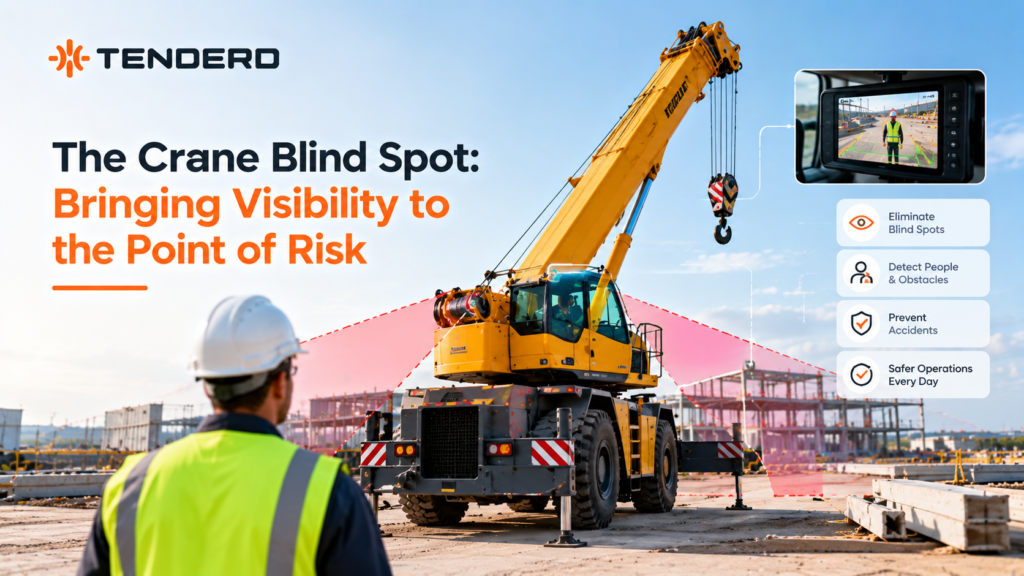
A crane blind spot is the area the operator cannot see from the cabin during a lift, typically the hook, the load line and the ground beneath the load. More than half of crane-related fatalities involve a worker being struck by an object or equipment, and most occur in that space. Mounting a camera on the hook block puts a live view of it on the in-cabin monitor. Across reference deployments in NMDC and McDermott, TENDERD has recorded a 90% reduction in high-risk blind-spot crane events.
Key Takeaways
- The crane blind spot is structural, not a training failure. From a fixed cabin position, the hook moves and personnel move, and for parts of every lift the operator is working on instruction rather than sight.
- Struck-by events account for more than half of crane-related fatalities, and they happen in the blind spot.
- A camera mounted on the hook block travels with the load and holds the view for the whole lift, rather than covering a fixed area of the site.
- Detection on its own changes little. The measurable difference comes when an alert becomes an assigned action with closure confirmed on video.
What a crane blind spot actually is
Every crane has one. The operator sits in a cabin with a fixed viewpoint, often at height and at an angle to the work. The hook moves through three dimensions. The load rotates, swings and obscures what sits below it. Personnel enter and leave the area beneath the load continuously as the lift proceeds.
For meaningful portions of a lift, the operator is making decisions about a space they cannot directly observe. They rely on a banksman, a radio and experience. That system works most of the time, which is precisely why the exceptions are so costly: the controls are built on communication, and communication fails quietly.
Offshore the problem compounds. Deck congestion reduces sightlines. Vessel motion changes the geometry of the lift continuously. Night operations and weather remove what visibility remains. The blind spot is not a fixed area that can be surveyed once and designed out.
Why struck-by events dominate crane fatalities
More than half of all crane-related fatalities involve a worker being struck by an object or equipment. That statistic points at a moment rather than a category of risk, and it is worth being precise about which moment.
These are not primarily failures of lifting plans, rigging competence or equipment condition. They are failures of awareness in the seconds when the load and a person occupy the same space and nobody with the authority to stop the lift can see both at once. Electrical contact and crane overturning account for smaller shares of the total, and both are better addressed by existing engineering controls. The blind spot is the gap those controls do not reach.
How an AI camera at the hook block works
TENDERD’s AI Crane Camera mounts directly on the hook block and streams a live HD view to a monitor in the cabin. Because the camera travels with the hook, the operator keeps sight of the load, the load line and the surrounding work area for the duration of the lift, not only at the pick and the set.
The same feed runs detection. A person entering the area under a suspended load is flagged rather than simply recorded, which is the difference between a camera system and a safety control. The view holds in low light and in the dust and spray conditions that normally defeat fixed site cameras.
Practical specification matters as much as capability here, because the constraint on most sites is operational rather than technical. The unit is wireless and non-invasive. It mounts magnetically with a safety harness backup, installs in approximately two hours per crane with no structural modification, and is swappable between cranes. A rechargeable battery pack runs for about 44 hours, with dual packs recharging in the cabin. The in-cabin display is a 7-inch HD touch screen with wide viewing angles.
For offshore work the architecture carries equal weight. The edge system records locally and maintains a high-fidelity incident buffer at the crane. Alerts, metadata and short incident clips synchronize over the vessel’s existing connectivity without saturating it. Onshore HSE teams receive notification of critical events and can open the flagged event with its supporting footage from shore.
Detection is step one. Closure is the point.
This is where most camera deployments stall, and it is worth being blunt about why. Footage accumulates. Nobody owns the follow-up. The system becomes an archive consulted after an incident rather than a control that prevents the next one. The organization has paid for visibility and received storage.
TENDERD’s AI Safety Agents are designed to carry an event through a complete loop. The AI detects the event. The right people are alerted. The corrective action is assigned to a named owner. Closure is verified on video. The pattern feeds a trend that HSE teams can act on, so leading indicators replace month-old reports.
Every monitored crane keeps a timeline of payload activity, engagement and idling with the matching image one click away. When an incident or near miss is reported, HSE reviews what happened rather than relying on recollection. Footage access is role-based and audit-logged.
The agents expand what one HSE team can cover across more assets, work areas and operational signals. They do not remove the supervisor from the decision. Agents flag, assign and verify. People decide.
The practical questions before a deployment
Three questions decide whether a system like this is viable inside a live campaign, and they are rarely about the camera.
The first is whether it can be installed on an operating crane without taking the asset out of service. A two-hour non-invasive install clears that bar. A system requiring structural modification or a planned outage usually does not, regardless of its specification.
The second is whether it can be evaluated honestly. A pilot on one crane, measured against a defined baseline over a defined period, tells you more than a demonstration ever will. Any supplier unwilling to be assessed that way is telling you something.
The third is whether anything happens after the alert. If the deployment ends at detection, the organization has bought a recording device. The value is in the loop that follows.
The Bottom Line
The industry has spent years getting better at recording what went wrong. Investigations are more rigorous, reporting is more complete, and the data is better than it has ever been. None of that prevents the next struck-by event, because all of it happens afterward.
The harder and more valuable problem is seeing the risk while it is still forming, and making sure the observation reaches someone with the authority and the obligation to act on it. That is what moving HSE from reactive to proactive actually requires, and it is less about the model than about the loop that runs from the field to a closed action.
TENDERD presented this argument at the Zuluf Offshore Safety Forum hosted by Saudi Aramco and NMDC Energy in August 2026.
To see what the hook camera view looks like on your own crane configuration, book a walkthrough.
Frequently Asked Questions
What causes most crane-related fatalities?
Workers being struck by an object or equipment. More than half of crane-related fatalities fall into this category. Electrical contact and crane overturning account for smaller shares.
Why can a crane operator not see the load?
The cabin has a fixed viewpoint while the hook, the load and the personnel beneath it all move. Deck congestion, vessel motion, night work and weather reduce visibility further offshore. For parts of a lift the operator is working from a banksman’s instructions rather than direct sight.
What is a hook block camera?
A camera mounted on the crane’s hook block rather than on the structure or the site. Because it travels with the hook, it keeps the load and the area beneath it in view throughout the lift instead of covering a fixed area.
How long does it take to install a crane camera?
Approximately two hours per crane for the TENDERD AI Crane Camera, with no structural modification. The unit mounts magnetically with a safety harness backup and can be swapped between cranes.
Does it work at night or in poor conditions?
Yes. The camera provides a continuous HD view of the hook and load line on the in-cabin monitor in low light and in challenging conditions, with AI detection running on the same feed.
What happens after the AI detects a hazard?
The event is flagged, the responsible supervisor is notified, the corrective action is assigned to a named owner, closure is confirmed on video, and the event feeds a trend. The supervisor makes the decision throughout.