 Summary
 Summary
Sustainable fleet operations means using real-time data on how vehicles and equipment actually run, especially the split between working and idling time, to cut fuel waste and carbon emissions together rather than treating them as separate problems. For fleets that mix vehicles with heavy equipment, idling is usually the largest recoverable source of emissions. At Aramco’s SPARK industrial city, real-time emissions monitoring helped the team cut idling emissions by 38% across 50 pieces of equipment within four months.
Key Takeaways
- Industry and transport, the two sectors closest to construction and logistics fleets, together account for 62% of global CO2 emissions from fuel combustion (IEA, 2024 data).
- Idling, not fuel type alone, is usually the largest recoverable source of emissions in a mixed fleet.
- Real-time emissions monitoring helped Aramco SPARK cut idling emissions by 38% across 50 pieces of equipment in four months.
- Clients and mega-project owners increasingly factor a contractor’s measured emissions performance into who wins the tender.
Living through a period where climate targets are no longer optional, industry leaders across construction, logistics and energy are turning to AI and real-time data to manage sustainability the same way they manage cost or schedule: as something to measure, not something to promise.
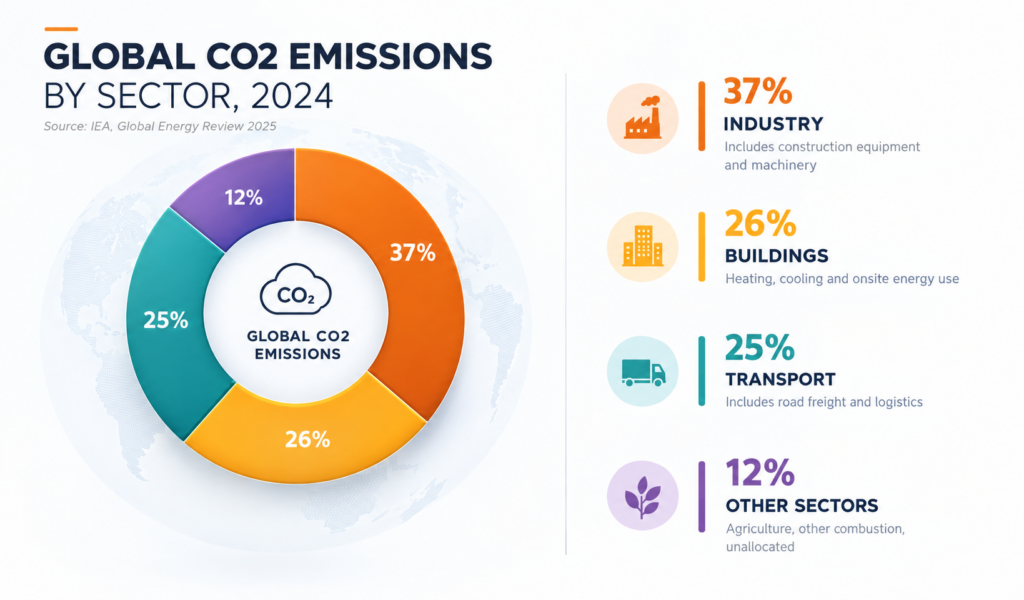
Global CO2 Emissions By Sector, 2024
Global emissions trends and the need for sustainable fleet management
Figure: Global CO2 emissions by sector, 2024 (most recent published data; source: IEA, Global Energy Review 2025).
According to the International Energy Agency’s Global Energy Review 2025, industry accounted for around 37% of global CO2 emissions from fuel combustion in 2024, with transport responsible for 25% and buildings for 26%. Construction activity sits within the industry share and logistics within transport, which means fleet-heavy sectors together drive well over half of global energy-related CO2 emissions. To move toward net-zero targets and a lower-carbon economy, these sectors need to reduce energy-intensive and wasteful operations, and fleet operations, heavy equipment on construction sites, vehicles for logistics, vessels for offshore work, sit at the center of that footprint across the supply chain.
As consumers expect greener operations and governments tighten net-zero regulation, companies are turning to technology to build lower-carbon value chains from end to end. Using AI in fleet management has become part of that shift: it gives a full view of fleet operations, including how vehicles, heavy equipment and vessels are actually used, so fleet size, age and efficiency can be tracked and acted on with data rather than assumption. Net-zero commitments are also becoming a brand and talent question, not just an operations one: how a company performs on emissions increasingly factors into its standing with clients, investors and the employees it’s trying to retain.
Fleet operations that run on diesel or gasoline produce significant CO2 through fuel combustion, and even fleets using alternative fuels or electric vehicles still carry some emissions depending on how that electricity is generated. Optimizing fleet efficiency and cutting fuel consumption is still the most direct lever most operators have for reducing their carbon footprint today.
Adopting sustainable fleet practices used to be a hard sell. A decade ago, fleet managers were cautious about new technology given the cost of implementation, training and the risk of disruption. Five barriers came up again and again: unawareness of the potential benefits, scarcity of proven technology, upfront cost, doubts about reliability and performance, and a lack of any real incentive to move first.
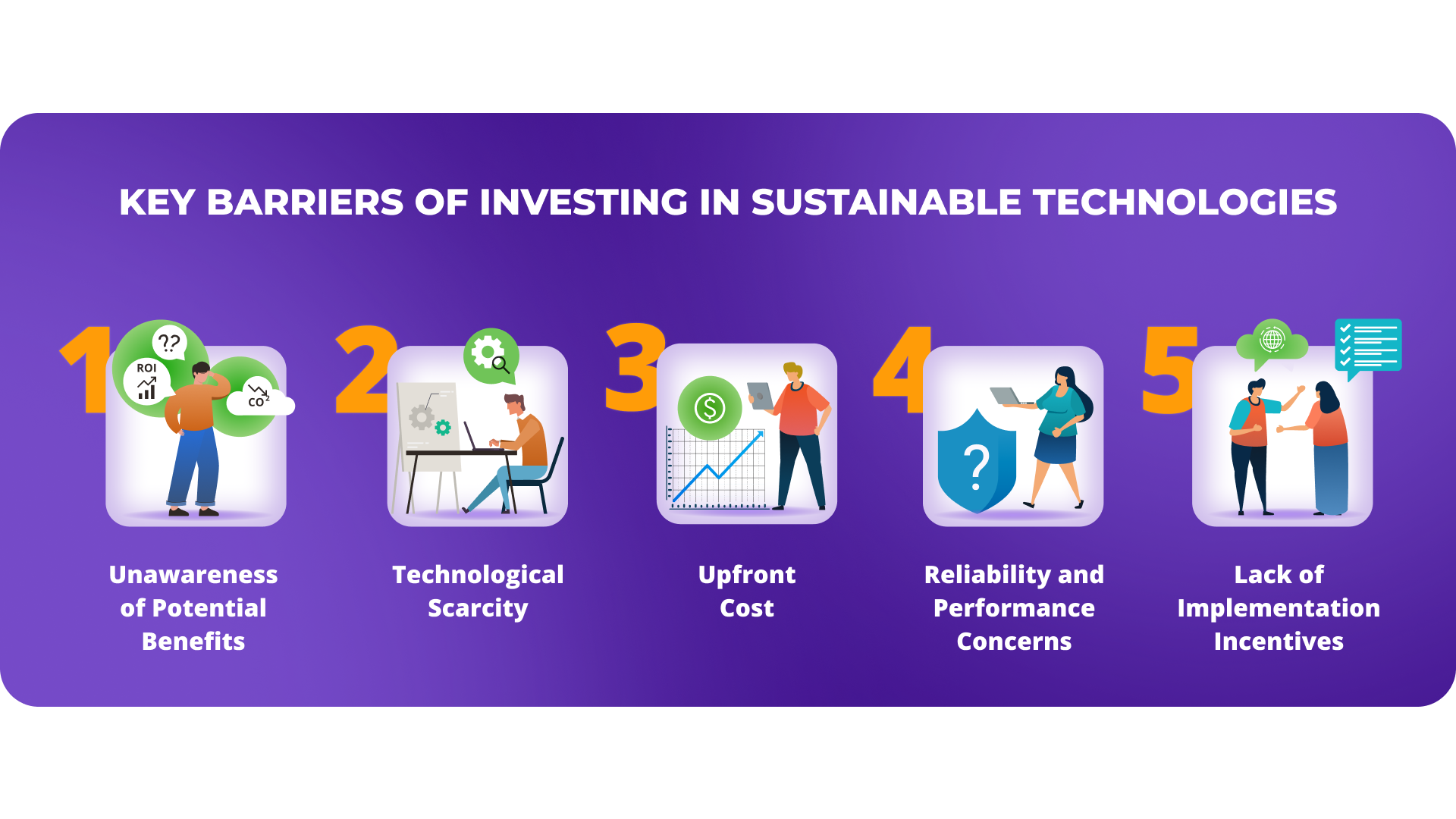
Connected fleet management for improved operational visibility
Companies that invested early were able to work through these barriers and differentiate themselves through how they operated and the value they could show clients. Today, more companies are making that shift, while others that delay risk falling behind on both cost and client expectations, since sustainability is increasingly a factor in who wins the work, not just how it’s marketed.
Cost-Benefit Analysis of Fleet Management Solutions
Before committing to a fleet management platform, most companies run a cost-benefit analysis: purchase price, training costs, subscription cost, expected savings, efficiency gains, and contribution to sustainability targets. Weighing these factors properly is what separates a good technology decision from an expensive one.
Fleet management software ranges from basic location tracking to feature-rich, machine-specific platforms that generate real efficiency and cost gains. The right choice is the one that delivers the clearest reduction in operating cost, fuel and maintenance, while also cutting the fleet’s carbon footprint, not a platform that only shows where an asset is.
Using Fleet Sustainability to Leave a Sustainable Ecological Footprint
The clearest evidence for what real-time data can do comes from Aramco’s SPARK industrial city. Using Tenderd’s emissions monitoring system, the SPARK team made data-driven decisions to increase equipment productivity and reduce idling, which resulted in a 38% reduction in idling emissions across 50 pieces of equipment over four months. Looking ahead, that kind of measured, sustained reduction is what makes sustainable fleet operations a genuine differentiator rather than a talking point.
There are real costs to weigh, but the benefits are just as real. Investing in operational intelligence supports cost-effective operations by giving real-time visibility into equipment utilization, productivity and carbon emissions, alongside AI-driven insights that turn that visibility into decisions.
Companies running feature-rich fleet management, with equipment-specific productivity tracking and real-time emissions monitoring, tend to run more efficient operations: projects delivered on time, with better safety and visibility, than companies still working from estimates. On mega-projects and tenders, multinational clients increasingly favor contractors with a demonstrably greener value chain and a clear efficiency and ROI story to back it up.
Digitizing operations is only the first step. The harder part is using the resulting data well. Many companies collect terabytes of site data and still lose sight of where improvement is possible, which leads to decisions made on instinct rather than evidence. Feature-rich fleet management software closes that gap by turning that data into actionable intelligence through AI, so decisions are based on what the fleet is actually doing rather than what it’s assumed to be doing.
The companies that have made this shift already have a real edge: a faster, better-evidenced path to a lower-carbon, more efficient operation than those still waiting to start.
The Bottom Line
Sustainable fleet operations stop being a promise once they’re built on real working and idling data instead of estimates. For a mixed fleet running vehicles and heavy equipment across construction, energy or logistics, the fastest path to a lower carbon footprint is usually already sitting in the fleet’s own engine-on data. See what that split looks like on your own fleet with a demo of TENDERD’s Emissions module.
Frequently Asked Questions
What is the biggest source of avoidable emissions in a mixed fleet?
Idling. A machine that is running but not working still burns fuel and produces CO2, and on most sites this goes untracked because it doesn't show up as a maintenance issue, only as a gap between engine-on hours and productive hours.
How is fleet CO2 output actually measured?
From the fleet's own engine-on time, fuel consumption and utilization data, split between working time and idling time, rather than estimated from a fuel invoice.
Does sustainable fleet management apply to equipment that isn't electric?
Yes. Idling and utilization data applies to diesel and other combustion equipment just as much as to electric vehicles, and for most heavy-equipment fleets it's where the nearer-term reduction is actually available.
How does emissions data affect tender or contract eligibility in the UAE and GCC?
It's increasingly a factor project owners and multinational clients ask about directly, alongside cost and schedule, particularly on mega-projects with their own sustainability commitments to report against.
How quickly can a fleet see a measurable emissions reduction?
At Aramco's SPARK industrial city, real-time emissions monitoring across 50 pieces of equipment produced a 38% reduction in idling emissions within four months, though results depend on fleet size, equipment mix and how consistently idling reduction is enforced on site.