 Summary
 Summary
At the Zuluf Offshore Safety Forum, hosted by Saudi Aramco and NMDC Energy, TENDERD showed how its AI Crane Camera and AI-driven safety workflows close crane blind spots and move offshore HSE from reactive reporting to real-time prevention. The same visibility approach also applies to generator emissions.
Risk on a site is continuous, but human attention is not. That gap, and what closes it, was the subject of our session in Al Khobar.
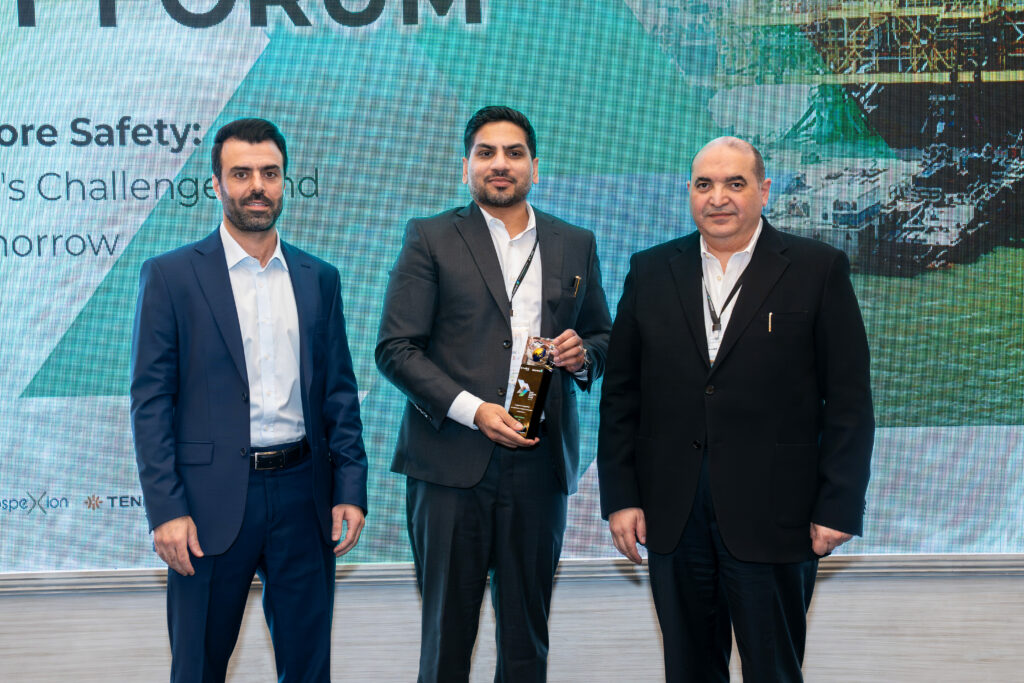
On 26 August 2026, Saudi Aramco and NMDC Energy convened the Zuluf Offshore Safety Forum in Al Khobar. The purpose was direct: bring subject matter experts and technology vendors into the same room as the project and loss prevention teams running offshore work, examine the risks that matter most, and identify what is actually deployable across contracting partner scopes.
TENDERD was invited as one of the technology partners. Our Founder and CEO, Arjun Mohan, presented “AI Safety Agents: Transforming HSE from Reactive to Proactive.” This is what the session covered and what the room pushed back on.
The gap the session opened on
Offshore HSE teams are not short of effort or intent. They are short of coverage. A supervisor can observe one lift at a time. A shift produces a handful of recorded observations. Reports arrive after the event, and investigations depend on what people remember weeks later.
Risk, meanwhile, does not pause between observations. It is continuous. Human attention is not. Every safety system built on periodic human monitoring inherits that limit, and no amount of additional training removes it.
The blind spot in lifting operations
We narrowed the argument to one measurable problem, because a general case for visibility persuades nobody in a room of lifting superintendents.
More than half of crane-related fatalities involve a worker being struck by an object or equipment. Those events occur in the seconds when the operator cannot see what matters. From a fixed cabin position, the hook moves, the load rotates, and personnel enter and leave the area beneath it. Offshore the problem compounds. Deck congestion, vessel motion, night operations and weather all reduce what is visible from the cabin.
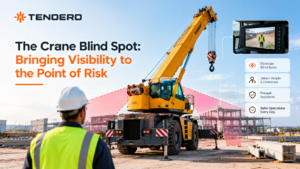
TENDERD’s AI Crane Camera mounts directly on the hook block and gives the operator a live view of the hook, the load and the surrounding personnel on an in-cabin monitor. Because the camera travels with the hook, that view holds for the duration of the lift rather than only at the start and the finish. This brings visibility directly to the point of risk, which is where it has always been needed and where it has rarely been available.
Across reference deployments in NMDC and McDermott, TENDERD has recorded a 90% reduction in high-risk blind-spot crane events.
From detection to closure
The second half of the session dealt with what happens after an event is detected, which is where most camera deployments stall. Footage accumulates. Nobody owns the follow-up. The system becomes an archive consulted after an incident rather than a control that prevents one.
AI Safety Agents are designed to move an event through a complete action loop: detect, alert, assign, verify and trend. The AI flags the event. The right people are notified. The corrective action receives a named owner. Closure is confirmed on video. The pattern then feeds a leading indicator rather than a month-old report.
The distinction worth holding onto is that this expands what one HSE team can cover across more assets, work areas and operational signals. It does not remove the supervisor from the decision. Agents flag, assign and verify. People decide.
The same visibility problem, applied to emissions
We also showed how the same approach applies to environmental performance. Generators are the largest single contributor to baseline Scope 1 emissions on most offshore operations, and they frequently run continuously at low average load, burning fuel without producing work.
A single vessel usually carries several engine generations, meters, controllers and communication paths, which is why emissions programs stall waiting for one clean source system. TENDERD instruments mixed equipment using whichever integration method each asset allows, then resolves the data per engine. That resolution is what makes the number useful, because it separates working burn from idling burn and points at load balancing, maintenance condition or scheduling as the intervention.
What the delegation asked about
During the forum we demonstrated the AI Crane Camera and AI Safety Agent technologies to the visiting delegation, including senior leadership from Saudi Aramco and NMDC Energy. The delegation included Mohammed Al-Qahtani, Vice President at Saudi Aramco, and Eng. Hesham Awda, COO, Offshore at NMDC Energy.
The discussions focused on practical applications: how AI can improve lifting safety, how HSE visibility can be expanded across more assets, and how response times can be shortened across complex offshore operations. These are implementation questions rather than technology questions, and they are the right ones. A system that cannot be installed on an operating crane, or that depends on replacing serviceable equipment, will not clear the bar regardless of how it performs in a demonstration.
What we took from the day
The strongest signal from the room was that the offshore industry has become good at recording what went wrong and is now looking seriously at seeing it while it is still happening. That is a harder problem, and it is less about the model than about the loop that runs from the field to a closed action.
We are grateful to Saudi Aramco and NMDC Energy for the invitation, and for a forum that kept the discussion on practical implementation.
If lifting visibility is a gap on your scope, book a walkthrough with our team and we will work through it against your crane configuration.