 Summary
 Summary
Fleet management software is a platform that gives fleet managers full visibility into their operations by tracking vehicles and equipment, monitoring fuel and maintenance activity, scoring driver safety, and generating reports from one connected system. The features that matter most are real-time analytics, AI-driven insight, fuel loss detection, predictive maintenance, driver behavior scoring, route optimization, and contract management, because together they turn scattered fleet data into decisions that reduce cost, downtime, and risk.
Key takeaways
- What is fleet management software? It’s a platform that tracks vehicles and equipment, monitors fuel and maintenance, and scores driver safety, all from one connected system.
- Real-time tracking gives fleet managers live visibility across every vehicle and machine, instead of a monthly rollup that is already out of date.
- Fuel monitoring and predictive maintenance catch problems, such as a fuel loss or a developing failure, early enough to act before they turn costly.
- A smart fleet relies on AI-driven insight, driver behaviour scoring, and compliance tracking working together, not as separate tools.
- Platforms like TENDERD bring tracking, fuel, maintenance, and safety data into a single system, so decisions do not depend on switching between disconnected tools.
Introduction
Running a fleet today means more than knowing where a vehicle is. Fleet managers are expected to control fuel costs, keep drivers safe, catch maintenance issues before they turn into breakdowns, and prove all of it to finance and compliance teams, often from a spreadsheet that is already a week out of date. Fleet management software exists to close that gap, giving teams one place to see what is happening across their vehicles and equipment instead of piecing it together after the fact.
The category has moved fast. Where early platforms mainly plotted a dot on a map, modern fleet management software pulls in live telemetry, driver behaviour data, fuel sensors, and maintenance records, then uses ai to flag what actually needs attention. The result is a shift from reacting to problems to catching them early enough to do something about them.
This guide walks through the features that matter most when evaluating fleet management software, how they fit together, and what to look for depending on the size and complexity of your fleet.
What is fleet management software?
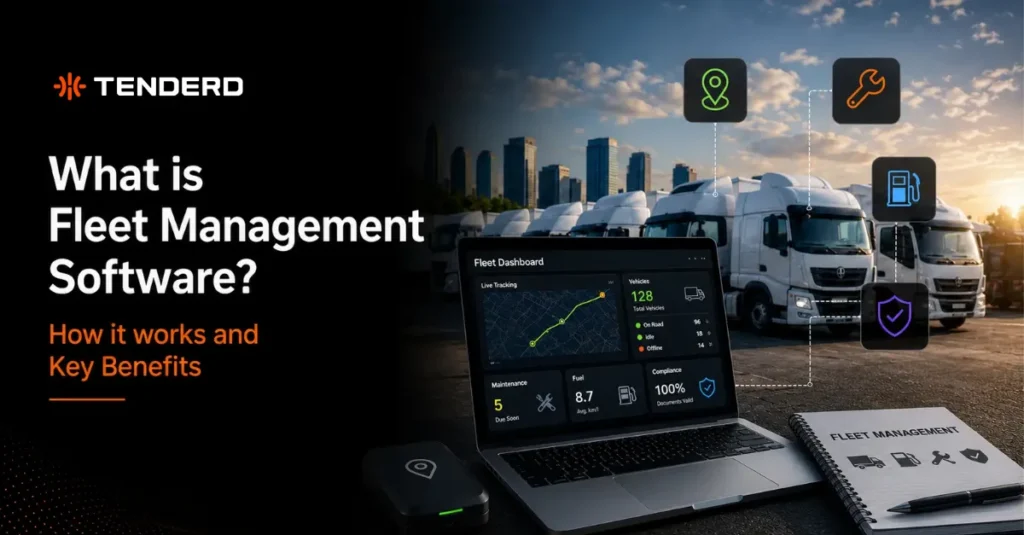
Fleet management software is a platform that tracks, analyses, and helps optimize vehicles, equipment, drivers, and the operational processes around them, typically combining location tracking, fuel monitoring, maintenance scheduling, driver safety, and reporting into one connected system.
For fleets running dozens or thousands of assets, that visibility is what turns scattered data into decisions that actually reduce cost and risk.
How Does Fleet Management Software Work?
Here is how fleet management software typically works, from data capture to action:
- Data Capture: Sensors on each vehicle or machine continuously collect data on location, fuel, engine status, and driver behaviour.
- Analysis: The platform analyses that data against defined parameters and assigns a confidence score to flag issues such as fuel waste, harsh braking, or an upcoming maintenance need.
- Alert: Relevant events surface to the right person in real time, whether that is a safety manager reviewing a violation or a maintenance planner seeing an asset move into an overdue state, with AI Agents able to escalate urgent issues directly to the right person.
- Report and Act: Dashboards and reports let teams review performance over time, while automated workflows turn insight into action without manual follow-up.
Why is Fleet Management Software Important?
Operating a fleet carries a lot of hidden cost. Fuel quietly disappears to idling or theft, a machine breaks down because a preventive service window was missed, and none of this shows up cleanly in a spreadsheet updated once a month. That is why small issues tend to compound instead of getting caught early.
Fleet management software solves this by closing the visibility gap in real time, giving operations, maintenance, and finance teams a shared, current view of the same data instead of each working from a different version of it.
Key Benefits and Features That Drive Smarter Fleet Operations
Here are the features that separate a basic tracking tool from a platform that changes how a fleet is actually run:
- Real-Time Analytics and Reporting
Fleets generate large amounts of data every day: location, fuel consumption, maintenance activity, and driving patterns. Fleet management software turns that raw data into reports and dashboards broken down by driver, vehicle, region, or business unit, so managers can see what is happening without waiting for a scheduled report.
- AI-Powered Insights and Predictive Analytics
AI plays a significant role in fleet management by identifying patterns in the data that a person might miss, such as inefficient driving, a fuel consumption trend moving in the wrong direction, or a maintenance issue likely to surface weeks before it affects operations.
- Driver Behaviour Monitoring and Safety Scoring
Monitoring driver behaviour reduces the chances of accidents because it turns unsafe driving patterns, such as harsh braking and speeding, into a scored, trackable record rather than something a manager learns about only after a complaint or an accident. With performance ranked this way, fleet managers can coach drivers using actual data rather than anecdote.
- How Does Fleet Management Software Reduce Fuel Costs?
Fleet management software reduces fuel costs by distinguishing between fuel used for actual work and fuel lost to idling, and by flagging unexpected drops or refills. That means fuel waste or theft does not go unnoticed until the monthly report arrives, and idling, typically the largest source of wasted fuel, gets caught instead of going undetected.
- How Does Predictive Maintenance Reduce Downtime?
Predictive maintenance reduces downtime by detecting a developing failure before it reaches the point a time-based service schedule would catch it, giving maintenance teams advance notice to act before it turns into a breakdown. Tools that track service intervals against actual usage, whether engine hours or distance covered, and project a machine’s condition against its existing schedule, turn unplanned downtime into a planned maintenance visit.
- Contract, Cost, and Vendor Management
Beyond the vehicles themselves, fleets carry contracts such as leases and insurance policies that are easy to lose track of. Centralizing expiration dates and invoices in the same platform used for operational data helps prevent missed payments and gives finance a clearer picture of true fleet cost.
“Fuel consumed during unnecessary idling can represent a measurable operating cost. Independent research on heavy-duty vehicles has recorded diesel consumption of approximately 2.57 litres per hour during idling, while research on diesel vehicles has reported rates as high as 1.85 gallons per hour under certain operating conditions.” Source
Types of fleet management software used in various industries
Fleet management software is different when used across different industries:
In construction and heavy equipment
Although telematics-oriented fleet management software is used across various industries, construction companies deploy it in the context of project-based job sites where it is crucial to understand where the vehicle is being underutilized and when a piece of machinery is reaching its maintenance due date. In this case, the emphasis lies on monitoring machine utilization as well as on predictive maintenance.
In logistics and transportation
In logistics and transportation, fleet management software benefits from monitoring the reliability of routes, fuel costs, and safety of the drivers. Real-time tracking of deliveries and identifying the behaviour of drivers help businesses meet delivery deadlines while saving on almost the only two costs that rise with the fleet size, such as fuel or incidents.
In energy, oil, gas and mining industries
The fleets operating in this industry do most of their work in dangerous or remote locations; therefore, the importance of compliance reporting, geofencing, or proximity detection rises significantly compared to that in delivery fleets.
In Consumer Goods
Consumer goods companies run distribution fleets that need to hit tight delivery windows across many stops a day. Route reliability and fuel cost tend to matter most here, alongside visibility into vehicle utilization across large delivery networks.
In Maritime and Ports
Maritime and port operations manage a mix of vehicles, cranes, and specialized equipment across a single facility. Utilization tracking and maintenance scheduling carry more weight here, since equipment downtime at a port can affect an entire operation’s throughput.
In Manufacturing
Manufacturing sites run internal fleets of forklifts, loaders, and transport vehicles moving materials between production areas and warehouses. Utilization tracking and preventive maintenance are typically the priority, since unplanned equipment downtime on a production line carries a direct cost.
Common challenges
The effectiveness of fleet management software depends considerably on the hardware that supplies information to it. If the vehicle does not have an appropriate fuel sensor, for instance, it will not provide any information about the working time compared to idling or about fuel theft; it will only give an approximate total. One should treat sensor coverage not as an issue that can be solved after the implementation has begun, but as a problem that has to be addressed in advance.
The implementation of the new platform in a large fleet requires real change management as well. Drivers and technicians who are used to paper records or outdated systems need to be educated and given valid reasons for introducing a new system; otherwise, the software will not be used in the way it was intended.
Simply accumulating a lot of information does not guarantee improved choices. If the alerts are not set up with proper boundaries and accountability, employees might find themselves looking at dashboards that no one monitors. The best solution is to set the software up to be useful for a team’s particular needs rather than just flipping it on as if it were preset.
Best practices for choosing and implementing fleet management software
When evaluating fleet management software, a few factors matter more than the feature list on a sales page:
1. Coverage across your actual asset mix
Check whether the platform genuinely supports the equipment types you run, not just standard vehicles, if your fleet includes generators, welding equipment, or heavy machinery alongside trucks.
2. Data you can trust
Look for confidence indicators on alerts, such as whether a fuel drop is real or sensor noise, rather than a system that treats every reading as fact.
3. Integration with existing systems
The platform should connect with your ERP, finance, or maintenance systems rather than becoming another disconnected data source.
4. Configurability by equipment and location
Rules that work for a sedan on a highway should not be forced onto a 30-ton trailer inside a restricted yard. Look for configuration options by machine type and by location.
5. Time to value
An implementation of a solution that lasts one year fails to yield ROI because it starts generating savings only when it goes live. It is preferable to ask the vendor to provide a realistic implementation schedule rather than merely demonstrating the features of the solution.
TENDERD is an example of the solution that contains all five key aspects: it has an appropriate coverage of various asset classes, the data is made reliable by scoring, it allows for the integration of the system, the configurability of the product is implemented for each machine separately, and its implementation is counted in weeks. As this combination is sometimes difficult to implement late in the project, it should be checked as early as possible.
Where TENDERD fits in
Fleet data commonly ends up scattered across tools that do not talk to each other: one system for tracking, another for fuel, another for maintenance. TENDERD ‘s platform is built to close that gap for organizations running mixed fleets of vehicles and heavy equipment, not vehicles alone, by putting tracking, fuel, safety, maintenance, and reporting on one shared data record per machine.
Three things make TENDERD different in practice. Its fuel intelligence separates working fuel from idling fuel per machine and flags drops or refills with a confidence score, so a fuel investigation starts from evidence rather than a guess. Its proactive maintenance ties preventive schedules, breakdown requests, and parts and labor cost into a single record per machine, tracked through five stages from overdue to completed. And its AI agent capability goes a step further than a dashboard alert: a predictive maintenance agent, for example, can project a developing failure against a machine’s existing service schedule and call the maintenance manager directly when the gap needs closing before the next scheduled visit.
Organizations using TENDERD have reported up to a 25% improvement in fuel efficiency, alongside smarter maintenance scheduling and clearer sustainability reporting. Fleets evaluating fleet management software for a mixed vehicle and equipment operation can book a demo to see how t TENDERD’s modules work together on their own data.
How TENDERD differs from point solutions
Traditional tracking devices have only the main feature of tracking the vehicle, which is why the TENDERD platform stands out from the rest. The table below indicates some direct comparisons between the two methods:
| Capability | Typical single-purpose tracking tool | TENDERD |
| Asset coverage | Vehicles only | Vehicles and heavy/mixed equipment in one platform |
| Real-time visibility | GPS location only | Live location, geofencing, and CAN bus diagnostics, plus a full per-machine record (documents, specs, violation history) in one profile |
| Driver and operator safety | Basic overspeed alert | Multiple tracked violation types with driver scoring |
| Utilization and productivity | Not tracked, or manual | Configurable daily targets by machine type, with drill-down from fleet-level to individual machine performance |
| Fuel investigation | Manual reconciliation at month-end | Automated drop/refill detection with an event replay |
| Maintenance | Separate system, manually scheduled | Preventive and reactive maintenance tied to cost, parts, and labor in one record. |
| Response to risk | Dashboard alert only | AI agents can escalate directly to the right person at the right time. |
| Sustainability reporting | Add-on or unavailable | Built-in fuel efficiency and emissions reporting. |
There is certainly a plus of using an integrated platform instead of the regular tracking tool, and it is not just about having more features. It is the fact that there is only one data source not multiple ones. It implies that, thanks to having all fuel, safety, tracking, and maintenance data in one place, a user who would otherwise check three different systems, will simply have one screen to have all the relevant data in one place.
“Fragmented fleet data can create measurable administrative and operational inefficiencies. A 2025 U.S. Government Publishing Office audit found that manual and decentralized fleet processes undermined data capture and analysis; in one instance, five vehicles worth approximately $205,700 were not recorded in the organization’s asset system when they entered service.” Source
The Bottom Line
Fleet management software has progressed well beyond vehicle location tracking. Modern platforms integrate real-time analytics, artificial intelligence-based insights, fuel and upkeep tracking, and security assessments into a cohesive package. Selecting the optimal product requires consideration of your asset combination, extent of user-configurability needed, and urgency in obtaining benefits. For fleets running a mix of vehicles and heavy equipment, TENDERD brings that visibility into a single platform.
Book a demo to see how TENDERD’s fleet management software fits your fleet.
Frequently Asked Questions
What is fleet management software used for?
Fleet management software is used to track vehicle and equipment location, monitor fuel consumption and maintenance activity, evaluate driver safety, and generate reports that help fleet managers reduce costs and downtime. Most platforms combine these functions into one connected system rather than requiring separate tools for each task.
What does TENDERD do?
TENDERD is a fleet and equipment management platform that provides real-time tracking, telematics, utilization monitoring, maintenance insights, and emissions visibility across heavy industries such as construction, logistics, and energy.
What fleet and equipment management solutions does TENDERD offer?
TENDERD offers GPS tracking, mixed-fleet telematics, utilization analytics, preventive maintenance planning, fuel monitoring, emissions tracking, safety insights, and centralized reporting dashboards.
What are the key advantages of using TENDERD for fleet management?
TENDERD can help reduce fuel waste, minimize downtime, improve asset utilization, and strengthen compliance reporting by bringing tracking, fuel, maintenance, and safety data into one platform.
What does fleet management include?
Fleet management typically includes vehicle and equipment tracking, maintenance scheduling, fuel monitoring, driver behavior monitoring, compliance reporting, safety management, performance analytics, and emissions tracking.
How can TENDERD help improve fleet productivity and reduce operational costs?
TENDERD helps improve productivity and reduce costs by identifying underutilized assets, reducing idle time, automating maintenance alerts, optimizing fuel usage, and centralizing reporting into a single dashboard.
What features should I look for in fleet management software?
Look for real-time tracking, driver behavior analysis, fuel monitoring with theft and leak detection, and preventive maintenance scheduling, along with reporting that breaks down performance by vehicle, driver, or region.
Is fleet management software only for vehicles?
No. Many organizations use it to manage a mix of vehicles and heavy equipment, such as generators, welding machines, and construction machinery, especially in construction, energy, and industrial fleets.
How long does it take to implement fleet management software?
Implementation timelines vary by fleet size and hardware requirements, but a well-scoped rollout typically moves through sensor installation, configuration, and team training in a matter of weeks rather than months.