 Summary
 Summary
The best fleet safety monitoring software for heavy equipment is a platform built for off-road machines, not one adapted from on-road truck telematics. It should detect operator fatigue, speeding, and people near moving equipment, send real-time safety alerts to both the operator and the supervisor, and work across every brand of machine on site. For mixed fleets on construction, oil and gas, and mining sites in the UAE and wider GCC, TENDERD is built for that requirement.
Key Takeaways
- Most fleet safety software was designed for trucks and vans on public roads. Heavy equipment risk sits around the machine, at low speed, on shared sites.
- Six real-time alerts matter most: operator fatigue and distraction, a person near the machine, speeding, geofence breach, collision or impact, and machine health.
- For mixed fleets, a unified heavy-equipment platform beats separate OEM portals and standalone sensors because every machine follows the same site rules.
- Software supports site controls. It does not replace traffic management plans, spotters, or operator training.
What is Fleet Safety Monitoring Software?
Fleet safety monitoring software is a platform that collects data from telematics devices, cameras, and sensors on vehicles and equipment, detects unsafe events as they happen, and alerts the people who can act on them. It also keeps a record of every event for operator coaching, compliance reporting, and incident investigation.
On a road fleet, the unsafe events are mostly about driving: speeding, harsh braking, phone use. On a heavy equipment fleet, the list is wider. It includes people on foot inside a machine’s working zone, machines entering restricted areas, and tired operators at the end of a long shift.
Why do Heavy Equipment Fleets Need A Different Kind of Safety Software?
Heavy equipment fleets need different safety software because the main risk is contact between machines and people on site, not road collisions. According to OSHA, about 75% of struck-by fatalities involve heavy equipment such as trucks or cranes.
Three conditions make sites different from roads:
- The risk is around the machine. Excavators, wheel loaders, and cranes have large blind spots and work next to people on foot.
- The fleet is mixed. A single site can run machines from many manufacturers, owned by the contractor, rental companies, and subcontractors. On ALEC’s SeaWorld Abu Dhabi project, TENDERD connected 130 assets across 17 subcontractors.
- The site keeps changing. Haul roads, exclusion zones, and speed limits move as the project progresses. Safety rules in software have to move with them.
Software designed around public road rules does not account for any of these three conditions.
What Real-Time Safety Alerts Should Heavy Equipment Software Provide?
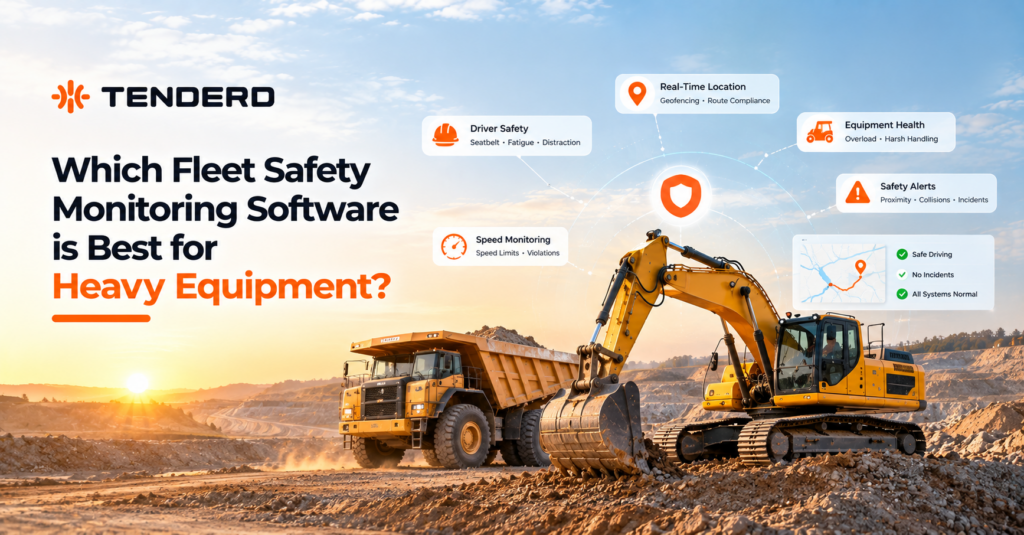
Heavy equipment safety software should provide six types of real-time alert. Each one maps to a common cause of serious site incidents.
| Alert | What triggers it | Who needs to know |
|---|---|---|
| Operator fatigue and distraction | An in-cabin camera detects signs of drowsiness, phone use, or the operator looking away | Operator at once, then supervisor |
| Person near the machine | A camera with AI detection identifies a person in the machine’s working zone | Operator at once |
| Speeding and speed zone breach | Speed goes above the site limit or a custom limit set for one zone | Operator and supervisor |
| Geofence breach | A machine enters a restricted area or leaves its approved working area | Supervisor and HSE team |
| Collision and impact | A forward collision risk or a physical impact is detected | Operator, supervisor, emergency response |
| Machine health risk | A fault or predictive maintenance alert appears on a safety-critical system | Maintenance team |
An alert only prevents an incident if it reaches someone in time to act. Ask every vendor how long it takes between the event and the alert, and what happens when the machine has no network coverage.
Which type of Fleet Safety Monitoring Software is Best?
For a mixed heavy-equipment fleet, a unified heavy-equipment fleet platform is the best type of fleet safety monitoring software. The other three types each solve part of the problem.
| Type of solution | Built for | Main strength | Limit for heavy equipment |
|---|---|---|---|
| On-road video telematics platform | Trucks, vans, and light vehicles on public roads | Mature dash cams and driver scoring | Designed around road rules and driving hours. Limited coverage of excavators, cranes, and loaders |
| OEM telematics portal | One manufacturer’s machines | Deep machine data for that brand | One portal per brand. No single view of a mixed or rented fleet |
| Standalone proximity or collision-avoidance system | Individual high-risk machines | Strong detection at the machine itself | Alerts often stay in the cab. Little fleet-wide reporting, and no link to location or maintenance data |
| Unified heavy-equipment fleet platform | Mixed fleets of vehicles and equipment across sites | Safety, location, and maintenance data in one system | Needs a hardware rollout and site-by-site setup |
If your fleet is mostly road vehicles, an on-road platform is usually enough. If your risk sits on site, among excavators, cranes, and people on foot, choose a platform built for that environment.
Where does TENDERD Fit?
TENDERD is a fleet and equipment management platform built for heavy industry, with its main footprint in the UAE and wider GCC. TENDERD’s Safety module uses AI to detect incidents, monitor operators, and support compliance across vehicles and heavy equipment.
TENDERD’s Safety module includes:
- In-cabin AI monitoring that detects operator fatigue, distraction, and unsafe behaviour in real time.
- AI-powered human detection and pedestrian awareness warnings around equipment.
- Forward collision and impact detection alerts.
- Real-time speed monitoring across sites, with geofencing and custom speed zones.
- Safety insights and reports on compliance, incidents, and operator behaviour.
The Safety module covers cranes, piling rigs, excavators, wheel loaders, bulldozers, motor graders, rollers, pavers, rigid haul trucks, and trucks. Because safety data sits in the same platform as Track and Maintenance, a supervisor can see where an event happened and whether the machine had an open fault. TENDERD reports a 50% reduction in safety violations across its deployments. Refer to our case studies.
See it on your fleet: Book a demo to see real-time safety alerts on your own mix of equipment.
Frequently Asked Questions
Which fleet safety monitoring software is best for heavy equipment?
The best fleet safety monitoring software for heavy equipment is a platform built for off-road machines that works across every brand on site. It should send real-time alerts for operator fatigue, speeding, geofence breaches, and people near moving equipment, and keep an event record for compliance. TENDERD is built for mixed heavy-equipment fleets in construction, oil and gas, and mining.
What are real-time safety alerts for heavy equipment?
Real-time safety alerts for heavy equipment are notifications sent the moment a system detects an unsafe event on or around a machine. Common alerts cover operator fatigue and distraction, a person inside the machine's working zone, speeding, entry into a restricted area, and collisions or impacts. The alert goes to the operator, the supervisor, or both.
Does fleet safety monitoring software work on cranes and excavators, or only on trucks?
It depends on the platform. Software designed for on-road fleets mainly covers trucks, vans, and light vehicles. Platforms built for heavy industry also cover off-road equipment. TENDERD's Safety module covers cranes, excavators, wheel loaders, bulldozers, motor graders, rollers, pavers, piling rigs, rigid haul trucks, and trucks.
Can fleet safety software monitor rented and subcontractor equipment?
Yes, if the platform uses telematics hardware that is independent of the machine manufacturer. The system can then monitor any machine it is installed on, whoever owns it. Agree installation and data access in the rental or subcontract terms before the machine arrives on site.
How fast should a real-time safety alert be?
The operator alert should sound in the cab the moment the event is detected. The supervisor alert should arrive within seconds, not in an end-of-day report. Ask each vendor to show the delay between event and alert on a live machine, and to explain what happens when the machine has no network coverage.